Someone says the brand needs 20 UGC videos this month. Nobody can explain why it’s 20, only that 20 sounds comforting in a spreadsheet. A few weeks later, the team has a folder full of similar clips, a paid campaign still missing the right proof, and one more meeting about “creative volume” as if quantity were a strategy.
If you're trying to decide how many UGC videos do you need, treat it as a scoping question, not a content appetite question. The sensible count comes from the decisions the footage must support on TikTok and Facebook.
That usually means four things: which message you need to test, what proof makes that message believable, whether one creator or several creator styles are needed, and how many edit versions each placement needs. Platform guidance can help with format and workflow. It does not hand you a universal monthly quota. TikTok’s ad creative guidance recommends native-feeling, human creative and suggests refreshing creative when performance weakens, while Meta’s Reels guidance points brands toward 9:16 video, audio, and safe-zone-aware design for Reels placements (TikTok creative advertising guide, Meta Reels ads guidance). Useful production constraints, yes. Magic number, no.
The real unit is a decision, not “one more video”
A content order is doing its job when it helps your team choose something specific next week. For paid social, that often means learning which opening earns attention, which demonstration answers the real objection, whether a calm explainer or a more informal creator delivery suits the product, and whether the edit survives the placement without burying the point under interface chrome.
That’s why a new creator saying the same script in the same room is not automatically a new test. Sometimes it is. Often it’s just more footage to approve.
This is especially true on Facebook. If the ad has to persuade a cold viewer, the proof usually matters more than the delivery style. Our guide on buying UGC videos for Facebook ads is helpful here because it starts with the claim the viewer needs to believe, then works backward to the shots that prove it. That is a better way to brief UGC than building a creator short list first and hoping clarity appears later.
Read the video transcript
You can order a big batch of UGC and still miss the proof your ads need, because a spreadsheet count can't explain what viewers must believe next. A smarter scope starts with decisions: which message to test, what evidence makes it credible, which creator style matters, and how many edits placements require. Weaker approach: buy more shoots by habit. Better approach: ask whether the issue is the opening, proof, or edit, though platform specs still shape what works. Imagine a cleanser campaign testing routine-led versus problem-led openings, texture proof, and two creator styles. That points to three concepts with variants, not a random monthly number. If TikTok holds attention but Facebook comments ask about daily use, the next brief should add reassurance footage, because new evidence matters more than repeating routine shots. Before approving any count, write the next three choices your footage must support on TikTok and Facebook. You'll buy enough to learn something useful, not just more files.
What TikTok and Facebook change, and what they don’t
TikTok and Facebook don’t require the same creative handling, so they shouldn’t inherit the same lazy batch count either.
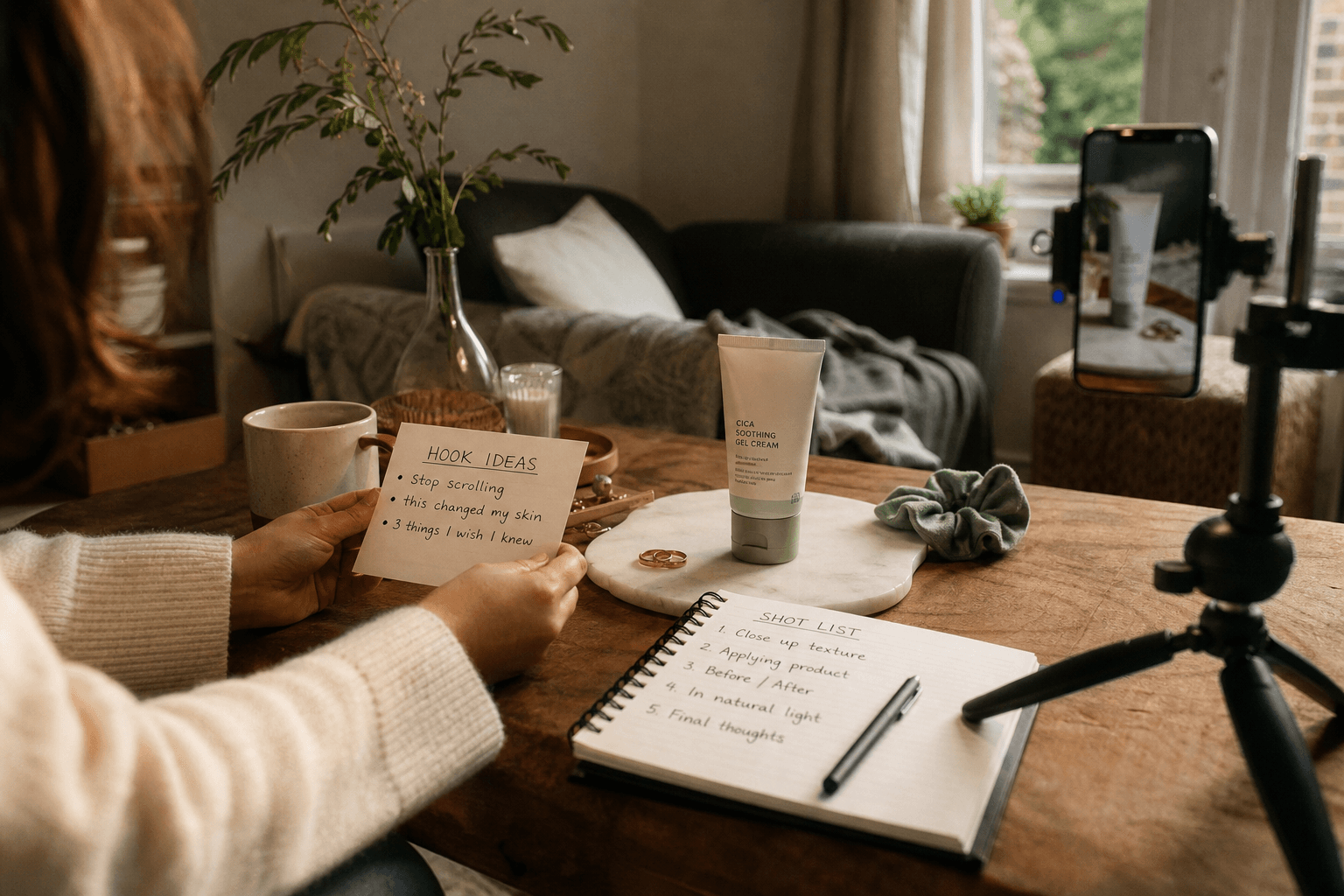
TikTok’s own guidance says ads that feel native, human, and direct are a strong fit for the platform, and it recommends captions or text for accessibility and comprehension (TikTok creative advertising guide). That matters when you scope a shoot. If the opening seconds do most of the work, one concept often needs several opening lines and first-frame options. A single polished master with no alternate starts is a brittle asset on TikTok.
TikTok’s rules also matter if creators are posting promotional content or appearing in content that qualifies as commercial promotion. TikTok says creators promoting a brand, product, or service must follow applicable laws and platform policies, and its policies require the platform’s disclosure tools where applicable (TikTok support on promoting a brand, product, or service, TikTok Community Guidelines). That doesn’t tell you how many assets to buy. It does tell you to settle creator-posted scope, approvals, and disclosures before production, not after someone has already filmed a charming but unusable post.
For Facebook and Instagram Reels placements, Meta’s guidance is more concrete about build specs: 9:16 video, audio, and safe zones for important visual elements (Meta Reels ads guidance). This changes the brief. If your Facebook version needs opening text, offer language, or captions, you should plan those in the safe area rather than discovering in review that the interface is sitting on your only useful line. And if creator-posted branded content is part of the Meta plan, Instagram’s Help Center says the paid partnership label is required when there is payment or another exchange of value (Instagram branded content guidance). Again, workflow and rights, not a universal volume target.
The pattern in the research is fairly clear. Platform guidance can tell you what the asset must accommodate. It cannot tell you that every brand needs 10, 20, or 50 UGC videos a month. The missing part is your decision map.
Scope the order with three questions
Start with three questions before you discuss quantity.
How many buying questions need proof on camera?
Count the viewer questions your next campaign must answer. Not every possible question. The next ones.
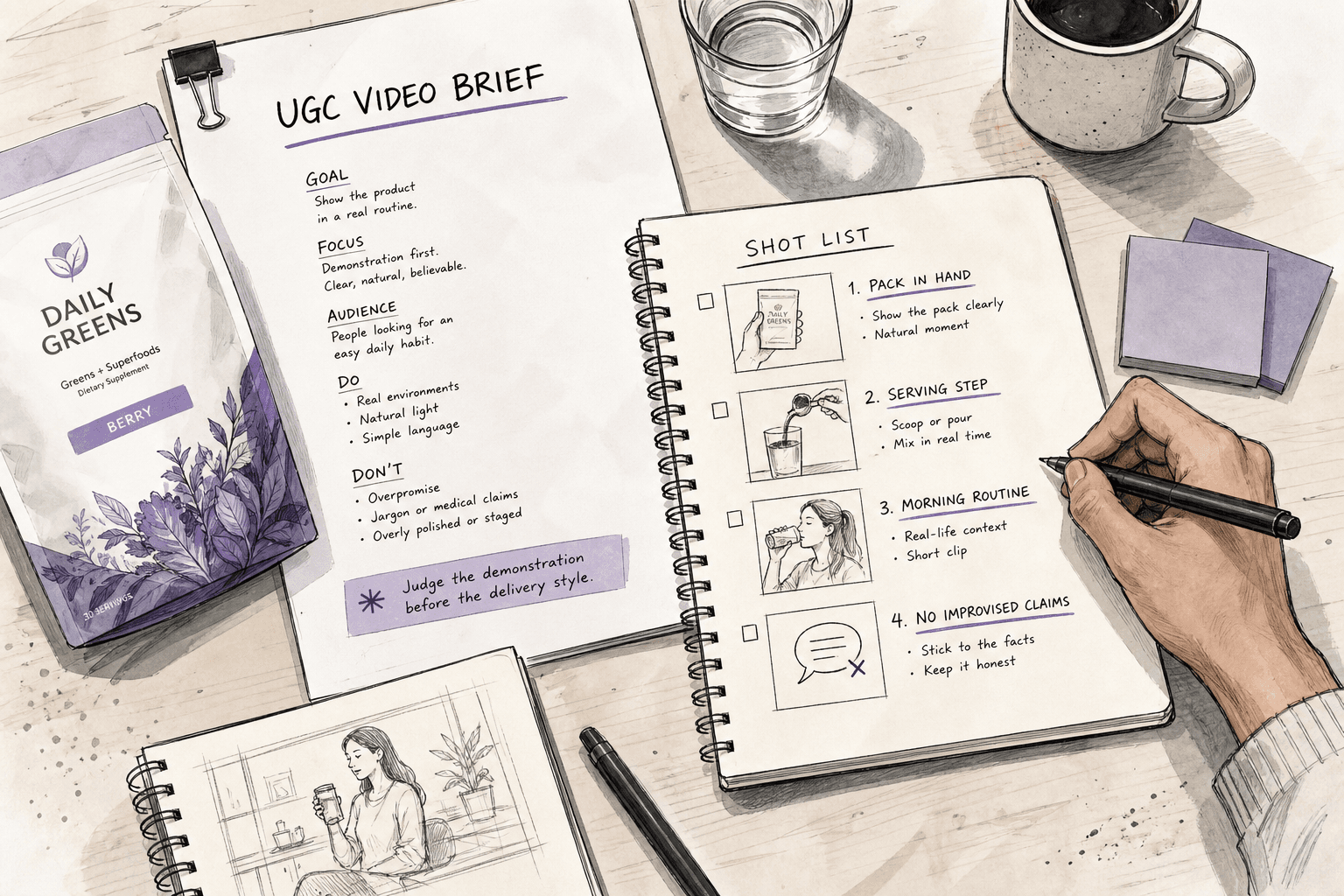
Say you sell a powdered greens product. Your paid campaign may need to answer three separate questions: what the product actually is, how it fits into a normal morning, and why someone would keep using it instead of forgetting about it after four days of good intentions. Those are different jobs. One creator can sometimes cover them, but one script usually won’t.
A useful brief note might look like this:
Concept 1: “What is it?” explainer
Job: make the product legible in under 10 seconds
Must-show shots: scoop, powder in water, mixed drink, package front
Sample opening lines: “If your greens powder needs a manual, that’s a problem.” / “Here’s what this actually is before anyone calls it wellness confetti.”
Concept 2: morning routine integration
Job: show where it fits in real life
Must-show shots: product beside breakfast prep, quick mix, sip while getting ready
Sample opening line: “I only keep habits that survive a normal weekday.”
That’s already enough to see why “we need 12 videos” is the wrong starting point. What you need first is coverage of two different decisions.
Do you need new ideas, new people, or new edits?
Teams often commission fresh shoots when the problem is actually in the edit.
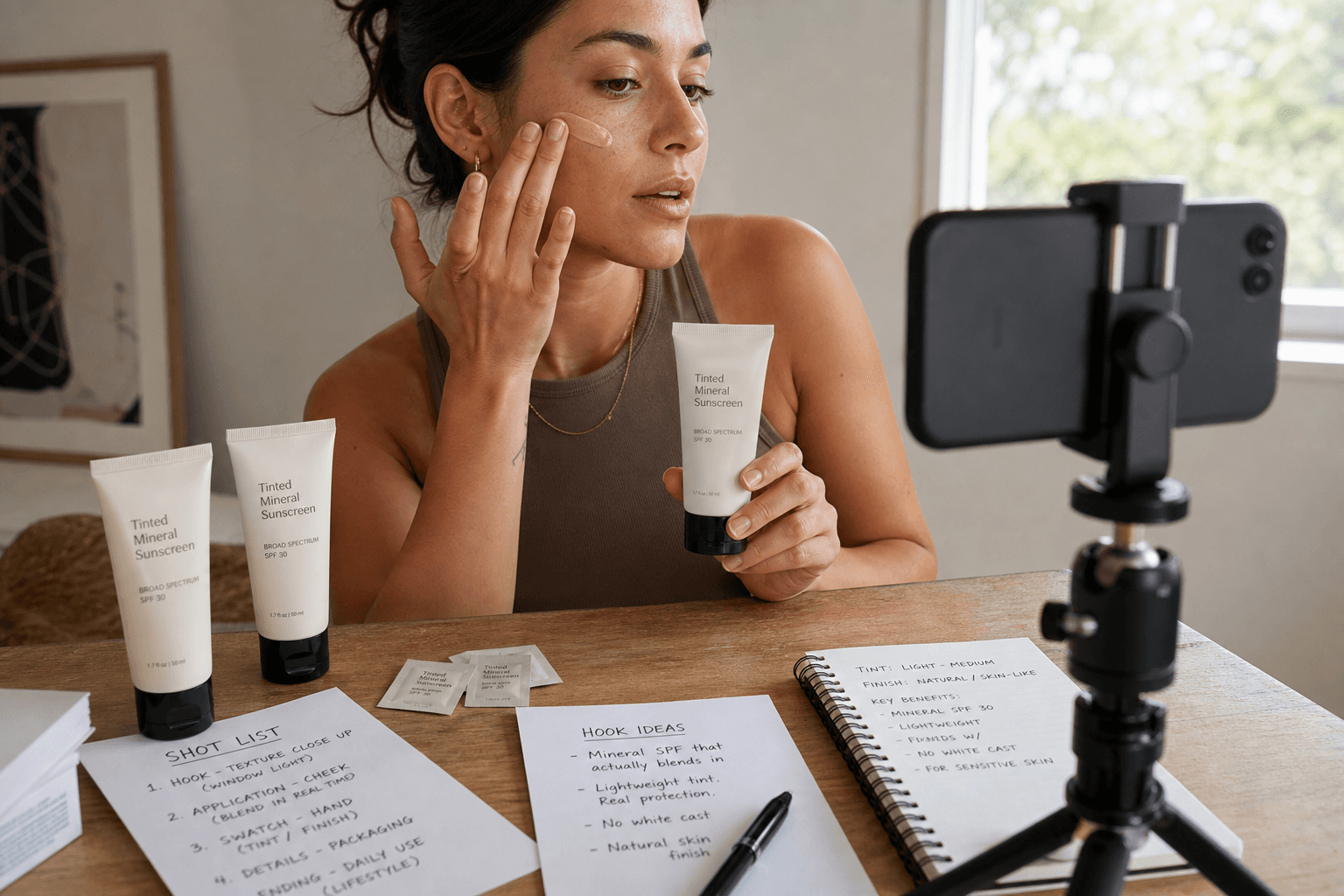
If viewers leave immediately, inspect the opening frame, first spoken line, and on-screen text. If people watch but don’t click, inspect when the benefit becomes clear and whether the offer arrives too late. If comments repeatedly ask how the product is used, inspect the footage itself: does it show use, or does it just talk around use? Each finding changes the next order differently.
That’s why Facebook ad creative editing: what to change before reshooting is worth reading before you assume the answer is more production. If the footage already contains truthful demonstration, a sharper opening, tighter pacing, different captions, or safer placement crops may solve the actual problem. Reshooting to avoid making an editing decision is an expensive hobby.
Are you buying for paid, organic, or both?
Paid usually needs planned variation. Organic usually needs a repeatable publishing rhythm.
If your team mostly needs regular posting, distribution, and iteration across channels, a one-off batch of creator videos may not be the main bottleneck. Zagged’s organic production and distribution process covers research, short-form production, distribution, reporting, and daily optimization across TikTok, Instagram, Facebook, and YouTube. That is a different scope from buying a batch of human UGC. Don’t ask a production order to solve an operations problem.
Worked example: one hero product across TikTok and Facebook
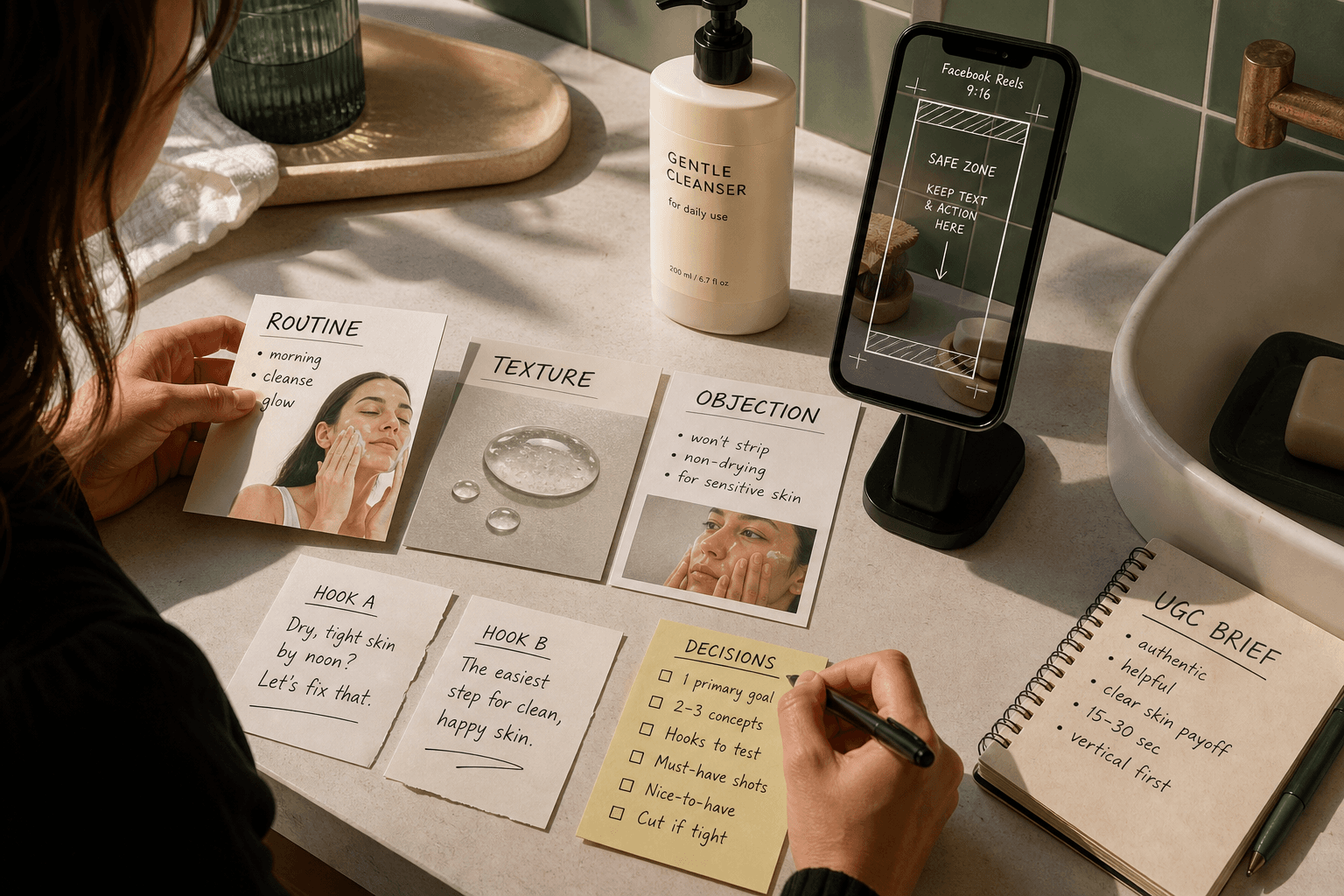
Imagine a skincare brand with one hero cleanser. The team wants human UGC for paid testing on TikTok and Facebook Reels. They do not need “content.” They need answers to three decisions:
- Is the stronger opening problem-led or routine-led?
- Does the cleanser need texture and application proof, or is spoken explanation enough?
- Does a calm, credible creator work better than a higher-energy creator for this category?
That leads to a sensible scope: three concepts, two creator styles, and multiple opening variations from each concept. Not a random monthly count. Not one precious hero video everyone is afraid to cut.
Here’s a workable concept note:
Concept: evening routine integration
Job: make the cleanser feel easy to adopt
Must-show shots: bottle in hand, texture close-up, one pump, application at sink, rinse, towel-off, product back on shelf
Opening options: “I stopped buying cleansers that feel like homework.” / “If a skincare step takes too much effort, I won’t keep it.”
Facebook edit note: keep opening text and any offer copy in the safe area for Reels placements
Now carry the same example into the next decision. Say the first batch goes live. On TikTok, the routine-led openings hold attention reasonably well. On Facebook, comments keep asking whether the cleanser is gentle enough for daily use. That finding changes the next order.
You do not need more of the same routine footage. You need a demonstration-led concept that answers the daily-use concern more directly.
A revised note could read:
Concept: texture and daily-use reassurance
Job: answer whether daily use feels realistic
Must-show shots: close texture shot, quick lather, rinse without fuss, skin after drying
Sample spoken line: “I use this at night because it feels simple enough to repeat, which is usually where routines fall apart for me.”
Notice what happened. The count changed because the evidence changed. That’s the point. You are not buying a monthly ration of UGC. You are buying enough coverage to make the next better decision.
If you want a tighter method for separating opening tests from full-creative changes, TikTok hook testing is a useful companion. It helps you keep the lesson small enough to use, instead of declaring that one entire ad “won” and learning nothing reusable from it.
Worked example: when the right number is fewer new shoots
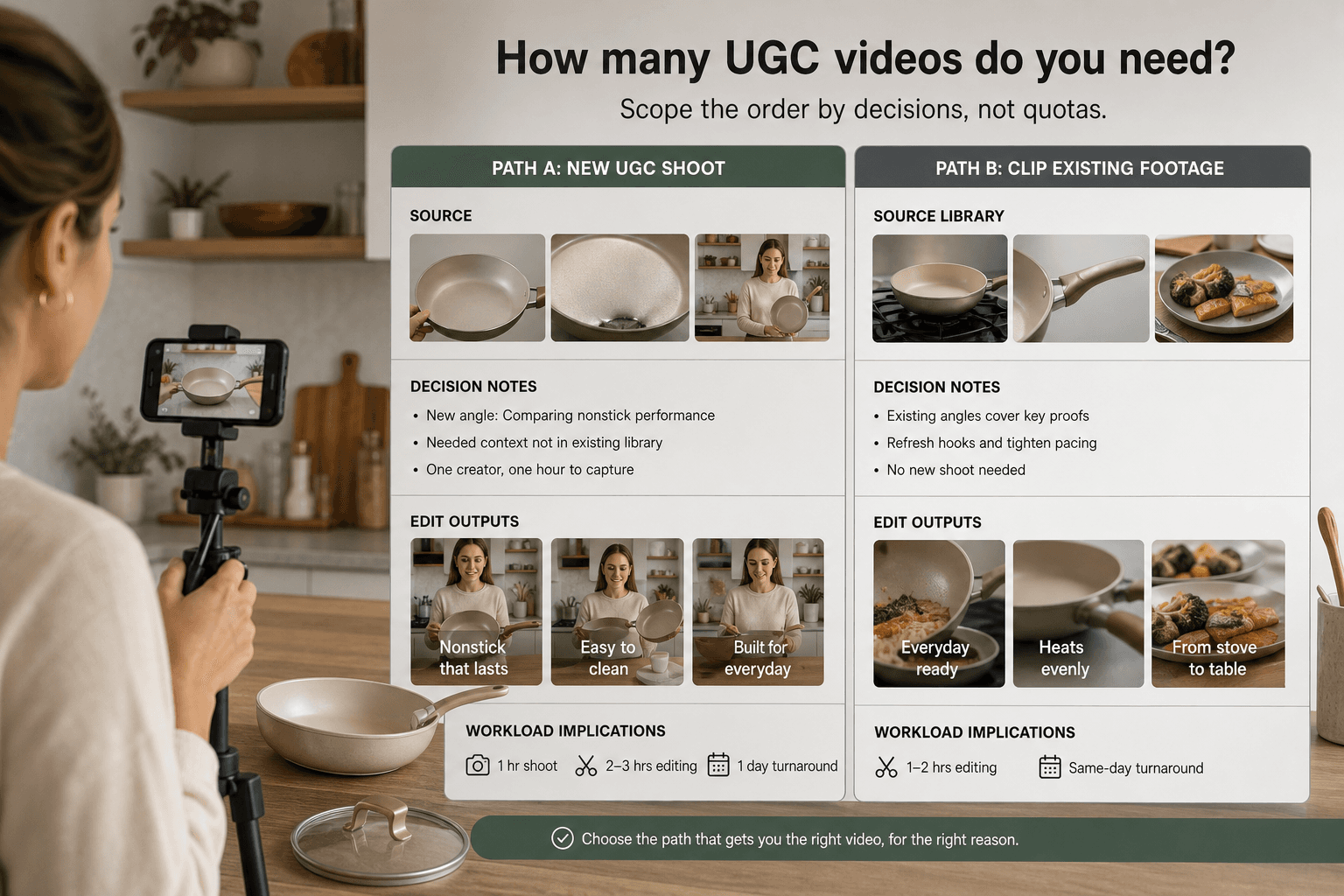
Now imagine a kitchenware brand with plenty of decent footage already sitting in Drive: creator demos, founder explanations, customer-question videos, and one long comparison piece from a launch period. The team asks how many UGC videos it needs next month.
Probably fewer than it thinks.
If the product truth is already on camera and the real bottleneck is turning that material into channel-ready shorts, a larger UGC order may be the wrong buy. In that case, repurposing is more sensible than commissioning more people to re-explain the pan.
A decision note for that team might look like this:
Use existing footage when: the product is clearly shown, the explanation is accurate, and the team mainly needs more hooks, trims, and placement-ready cuts
Commission new UGC when: the existing footage can’t honestly show the difference, lacks believable real use, or doesn’t fit TikTok and Facebook placements without awkward compromises
If clipping is the real bottleneck, send that work to Clippin, Zagged’s clipping business. And if you need help deciding what belongs in that first repurposing brief, what makes a clipping service worth hiring gives a clear standard: hire clipping when the source footage is already useful and the hard part is selecting, shaping, and delivering the right moments.
When outside UGC production is the better buy
Outside production makes sense when your team knows what the footage must prove but lacks the time or structure to source creators, brief them well, manage revisions, and return with paid-ready files.
That workload question matters more than people admit. If you need one small batch and your product is easy to show honestly, working directly with a creator may be enough. If the hard part is coordination across concepts, creators, edits, and approvals, managed help starts to earn its keep. Our guide on UGC creator vs UGC agency is useful if you’re choosing between doing the coordination yourself and paying someone else to own it.
If you already know the concepts you need and want human UGC made by real creators, Zagged’s public UGC offer is relevant because it includes a concept and hook, a real creator, editing and captions, a final video file, and paid and organic social usage. As of October 23, 2026, the live order page lists 50 to 200 fully edited videos at USD $99 each, with a minimum order of $4,950 (Zagged UGC order page). That is Zagged’s live offer, not an industry benchmark. It still leaves questions a careful buyer should settle in writing, including raw footage access, revision terms, exclusivity, creator posting, and advertising permissions.
If you’re comparing proposals, ready-to-post UGC cost is the right companion piece because it shows how to compare scope before you compare price. A low per-video rate is not especially impressive if your team has to absorb half the work the quote forgot to mention.
The next move is simple enough to do today. Write down the next three decisions your footage needs to support on TikTok and Facebook. Then scope the order around those decisions before anyone approves a video count.
Creator production brief
Turn a product idea into an assignment a creator can quote and film. Replace the example with your own details, then download the brief.
Send this before agreeing scope. Ask the creator to flag any shot they cannot demonstrate accurately. Confirm commercial terms separately; a creative brief does not grant usage rights.
See a completed example
- Product and viewer question
- Example: A compact coffee grinder. Can it fit on a small counter and make a single morning serving?
- What the camera needs to show
- Place the grinder beside a mug for scale. Load one serving, show the controls, and show the cleanup. Do not claim results we have not substantiated.
- Creator and setting
- A creator comfortable explaining a routine in their own words, filming in an ordinary kitchen with clear sound.
- Opening and spoken explanation
- Start with the cramped counter, then show where the grinder fits. Explain one benefit while demonstrating it; avoid reading a list of features.
- Finished files and source footage
- Confirm number and duration of finished videos, aspect ratios, captions, clean exports, alternate openings and whether raw footage is included.
- Claims and required disclosures
- Attach approved product facts. Flag sponsorship or AI disclosures required for the intended use. Do not script personal experience the creator has not had.
- Commercial terms to confirm
- Agree intended channels, paid use, duration, territory, likeness permissions, music clearance, revision scope and who approves publication.
- Review and delivery
- Name one approver. Set dates for concept, first cut and final delivery. Consolidate feedback into one response.
Make your own brief
Your entries stay in this tab. Download before leaving; they are not saved or sent to Zagged.
Sources & further reading
- Creative advertising guide | TikTok for Businessads.tiktok.com
- Promoting a brand, product, or service on TikTok | TikTok Supportsupport.tiktok.com
- Community Guidelines | TikToktiktok.com
- Instagram & Facebook Reels: Create Short Video Ads | Meta for Businessfacebook.com
- What is considered branded content | Instagram Help Centrefacebook.com
- Zagged UGCzagged.com
- Zagged UGC order pagezagged.com
- Clippinclippin.com
- Zagged process overviewzagged.com
Published by Zagged Editorial. Updated .