The expensive mistake is familiar: a team approves a charismatic creator, a trendy edit, and a hook everyone likes in the review doc, then the ad launches and still feels unconvincing. Not ugly. Not amateur. Just thin.
For UGC videos for Facebook ads, the first buying question is not whether the creator feels native to social. It's what a cold viewer needs to see on camera before your claim sounds believable. If the product needs proof, demonstration should drive the brief. Creator style and editing should support that proof, not stand in for it.
That point matters more in paid Facebook placements than in general organic content. A paid asset has a narrower job. It has to earn belief quickly, survive different placements, and avoid drifting into claims or endorsement language your team can't support. Meta's own guidance for Facebook and Instagram Reels points advertisers toward placement-specific creative, including 9:16 framing, audio, and safe-zone-aware design for Reels rather than one generic asset for every placement (Meta guidance for Facebook and Instagram Reels ads). The FTC, separately, says endorsers with a material connection to a brand should disclose it and should not make claims or describe experiences they haven't actually had (FTC guidance on endorsements, influencers, and reviews).
So the recommendation is simple: buy the proof first, then the performance.
Start with the claim, not the creator short list
Before you compare creators, decide what the ad needs to prove. Usually the campaign job is one of four things: show how the product works, make normal use feel believable, answer one specific objection, or adapt a proven concept to Facebook placements without rebuilding everything from scratch.
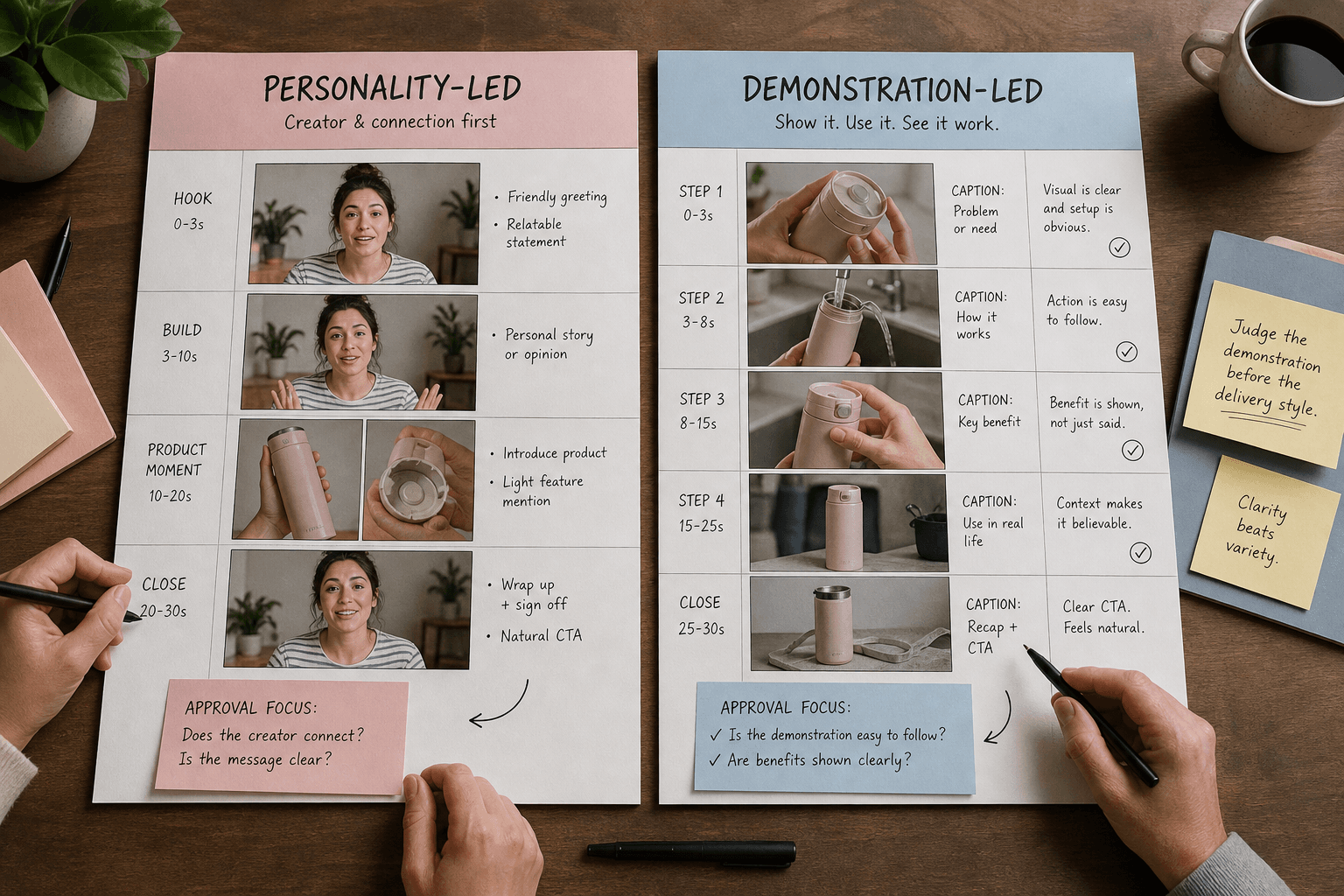
That choice should change the format you buy. If the main barrier is comprehension, an explainer is often the right shape. If the barrier is context, routine integration does more work. If the viewer mainly needs to see the product in a real setting, a demonstration-led script will usually outperform a vague “talk about why you love it” prompt, at least in the sense that it gives your team something concrete to approve.
Zagged's public human UGC portfolio labels formats in a useful way here: ingredient explainer, routine integration, and creator explainer (Zagged human UGC examples and scope). Those labels are not performance claims. They are a practical reminder that the creator's role should match the proof burden of the ad.
If you need a better way to judge that fit, how to find UGC creators who actually fit your brand is worth reading before you start outreach. The useful idea there is not “find someone on brand.” It's “turn the brief into something you can recognize in a portfolio.” For Facebook ads, that usually means looking for evidence that a creator can explain, demonstrate, or integrate the product truthfully on camera.
Read the video transcript
You can approve a charming creator and polished edit, then launch an ad that still doesn't persuade because viewers never actually see enough to believe the product. For Facebook ads, the better question is what a cold viewer must witness on camera. Style helps, but it can't replace visible proof or truthful, approvable footage. Before shortlisting creators, decide what the ad needs to prove: how it works, how it fits real life, or one objection it should answer. Imagine a supplement campaign: instead of asking for a free-form testimonial, brief a morning routine with the pack, serving step, and approved language only. Next, list the moments that must appear on camera, then frame for the placements you'll actually buy, so edits don't have to invent certainty later. Style can matter more when a product is instantly obvious, but most teams should review ads by what viewers saw before leaving and move proof earlier.
The screening question that saves rework
Before approving any concept, list what must appear on camera. If those proof points are missing from the planned footage, editing becomes a very expensive attempt to fake certainty.
Say you sell a countertop milk frother. The ad claim is not “better mornings.” That's copy. The viewer probably needs to see the device in hand, the setup, the motion, the foam texture, and the final pour. If the creator concept is mostly face-to-camera reaction with a few cutaway product shots, you have bought delivery style without enough demonstration.
A useful internal approval note could be as blunt as this:
"Don't approve on creator fit alone. We need one clean use sequence showing setup, operation, texture result, and final pour. If that sequence isn't in scope, we're asking the edit to manufacture proof."
That sentence does more work than another round of comments about energy.
When a demonstration-led brief is the safer buy
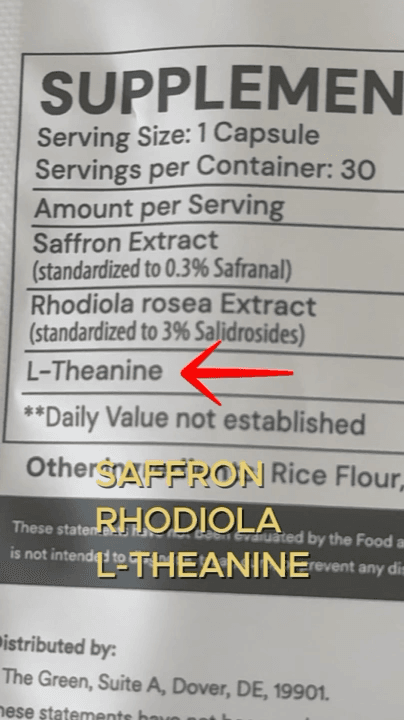
Choose a demonstration-led brief when the product asks the viewer to believe something specific about use, texture, fit, routine, setup, cleanup, or result. This is especially common in supplements, skincare, food and drink products, household tools, cleaning products, pet products, and low-consideration gadgets that still need to look real.
Here the usual “authentic testimonial” request is often the wrong buy.
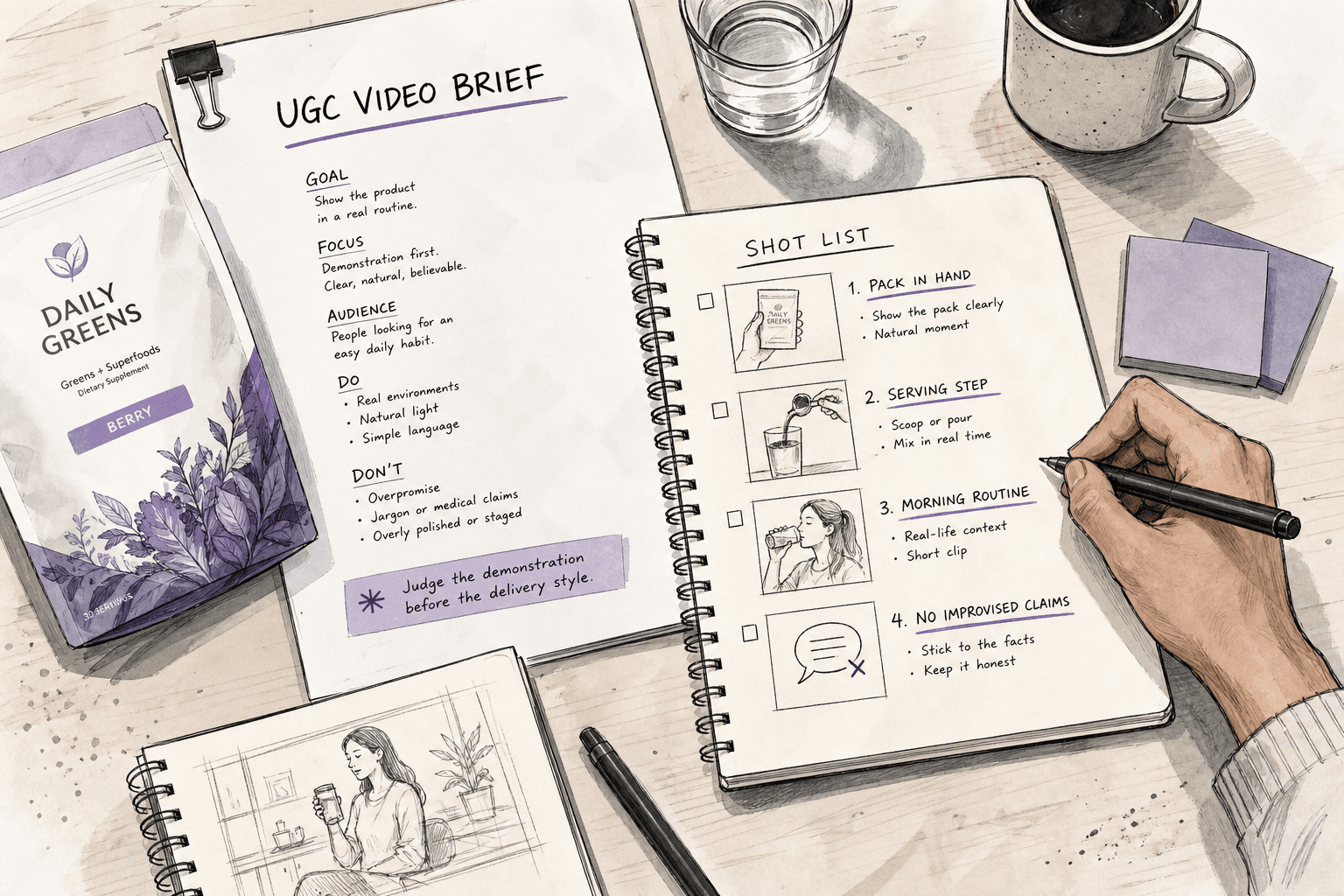
For example, imagine you sell a supplement and want UGC for a Facebook prospecting campaign. The weak brief says: “Give us a natural testimonial about how this changed your day.” That sounds efficient right up until legal, brand, and paid social all need to review it.
The problem is not only creative quality. It's also claims risk. The FTC says endorsers shouldn't describe experiences they haven't had, shouldn't make unsupported claims, and should clearly disclose material connections (FTC endorsement guidance; FTC endorsement Q&A). A loose testimonial prompt invites improvisation in exactly the category where improvisation is least helpful.
A better move is to change the creator's job.
Weak brief
“Give us a personal testimonial about better energy and fewer crashes.”
Stronger brief
“Film a morning routine with the pack visible. Show where the product lives in the routine, what the serving step looks like, and why the format is easy to remember. Use approved claims language only. Do not improvise personal outcomes or health effects.”
Usable script excerpt
“This is the one I keep next to the coffee machine because that's the part of my morning I don't skip. I'll show you the serving format and how it fits into breakfast.”
Now the creator is still speaking like a person, but the ad is built around visible, approvable proof. If your category carries higher claims sensitivity, this is usually the cleaner route.
Follow one example through the placement decision
The same supplement example gets more interesting when you decide where the ad will run.
If you plan to use Facebook Reels, the brief should account for vertical framing and safe zones from the start. Meta recommends 9:16 creative, audio, and safe-zone-aware design for Reels placements, and notes tools like manual placement choices and placement asset customization (Meta Reels ad guidance). That does not prove Reels will outperform Feed for your account. It does tell you that “one horizontal creator video for Facebook” is a sloppy production request when broad paid use is the plan.
A better production note for the same supplement concept might read like this:
Placement note for the brief
“Frame for 9:16. Keep the pack, serving action, and hand movement centered so the main proof survives crops. Leave top and bottom safe areas clear for captions and ad UI. Make the sequence understandable without sound, but capture natural audio in case the pour or package handling helps the ad feel less staged.”
Edit note
“Open on the pack in context or the serving step, not a generic greeting. If the first second doesn't tell the viewer what kind of product this is, move the routine action earlier.”
This is where some teams overcorrect and chase style instead. They'll ask for a faster hook, more cuts, larger captions, and stronger reactions. Fine, up to a point. But if the footage still doesn't show the product in a believable way, you're polishing around a missing demonstration.
That's the same logic behind Facebook ad creative editing: what to change before reshooting. Edit first when the problem is pacing, opening frames, or versioning. Reshoot when the footage never honestly showed the product in the first place.
When style deserves more of the brief
There are products where delivery style can carry more weight. If the product is visually obvious, inexpensive, and easy to understand in one glance, attention may be the main hurdle rather than explanation.
Say you sell a novelty kitchen accessory or a simple giftable add-on. In that case, you may choose the creator with stronger timing and a punchier opening even if the demonstration is lighter. The viewer probably doesn't need a lesson. They need to notice the item, get the use case, and imagine owning it.
Even here, though, the recommendation changes by degree, not by category. You are not abandoning proof. You are deciding that the proof burden is lighter. A quick before-and-after, one clear use shot, or a simple setup/result sequence may be enough. What you should not do is assume that personality alone will carry a paid ad once comments, crops, and silent viewing get involved.
If the creator will post, settle that before production
Some Facebook campaigns only need dark-posted ad creative built from creator footage. Others depend on creator-posted content or partner content workflows. Those are different buys. Treating them as the same is how a simple production order turns into a permissions argument at the worst possible moment.
Meta notes that businesses can promote existing reels and use partner content workflows, but the permissions have to be set appropriately (Meta guidance for Reels ads and partner content workflows). Meta also says branded content includes content influenced by a business partner in exchange for value, including free products, and that paid partnership labeling is required in those cases (Meta definition of branded content). That labeling framework does not replace FTC endorsement duties. It sits alongside them.
So if your paid campaign depends on creator-posted assets, confirm the operational details in writing before anyone films:
- who is posting the content
- what permissions the business needs to promote it
- whether paid partnership labeling applies
- whether the creator is speaking from actual experience or simply demonstrating approved use
Those are production questions, not legal footnotes. They affect who you hire and what footage you ask for.
Compare buying options on the same criteria
If you're choosing between working directly with a creator, using a managed partner, or producing more in-house, compare them against the same criteria: product truth, footage required, internal workload, iteration speed, delivery scope, and intended placement.
For a small batch, a simple product, and a team that can manage briefing, permissions, revisions, and approvals without slowing launch, working directly with a creator can be the better buy. If the hard part is coordination across multiple assets, paid usage, creator matching, and repeated variations, outside help tends to make more sense. UGC creator vs UGC agency: how to choose for your workload is useful here because it treats the decision as a workload question, which is usually what it is.
Scope also matters more than sticker price. If you compare quotes, compare what is actually being delivered for paid use. Ready-to-post UGC cost: compare the scope before the price is helpful because it breaks down what a paid-ready quote should spell out.
As one live example, Zagged's public human UGC offer includes a concept and hook, a real creator, editing and captions, a final video file, and paid and organic social usage (Zagged human UGC offer details). Its public order page showed 25 to 200 fully edited videos at USD $99 each, with a 25-video minimum totaling $2,475, as displayed on October 5, 2026 (Zagged UGC order pricing). That's a provider-specific offer, not an industry average. It also does not answer other questions you may care about, such as raw footage, exclusivity, revision rounds, creator posting, or advertising permissions. Those should be confirmed in writing.
If you already know you need human UGC rather than editing around existing footage, reviewing Zagged's human UGC offering and how the production process is organized can help you prepare a cleaner inquiry. Bring the campaign job, the placement plan, the claims guardrails, and the shots that must exist. That makes the conversation shorter and the output better.
What to inspect after launch
Don't just “track performance.” Inspect what viewers had seen before they left, and let that finding change the next brief.
If people drop before the product action appears, move proof earlier. If they stay through the demonstration but comments show basic confusion about setup or use, the footage needs a clearer sequence, not a louder hook. If the asset gets attention but the script drifts into broad claims that make approvals painful, tighten the role you gave the creator.
In other words, review the ad the way a buyer should have bought it: by what it proved, not by whether the creator seemed engaging in a vacuum.
The next move is to decide what your campaign needs the viewer to believe, write the proof into the brief as shots rather than adjectives, and choose a creator format that can carry that burden on Facebook placements you actually plan to buy.
Creator production brief
Turn a product idea into an assignment a creator can quote and film. Replace the example with your own details, then download the brief.
Send this before agreeing scope. Ask the creator to flag any shot they cannot demonstrate accurately. Confirm commercial terms separately; a creative brief does not grant usage rights.
See a completed example
- Product and viewer question
- Example: A compact coffee grinder. Can it fit on a small counter and make a single morning serving?
- What the camera needs to show
- Place the grinder beside a mug for scale. Load one serving, show the controls, and show the cleanup. Do not claim results we have not substantiated.
- Creator and setting
- A creator comfortable explaining a routine in their own words, filming in an ordinary kitchen with clear sound.
- Opening and spoken explanation
- Start with the cramped counter, then show where the grinder fits. Explain one benefit while demonstrating it; avoid reading a list of features.
- Finished files and source footage
- Confirm number and duration of finished videos, aspect ratios, captions, clean exports, alternate openings and whether raw footage is included.
- Claims and required disclosures
- Attach approved product facts. Flag sponsorship or AI disclosures required for the intended use. Do not script personal experience the creator has not had.
- Commercial terms to confirm
- Agree intended channels, paid use, duration, territory, likeness permissions, music clearance, revision scope and who approves publication.
- Review and delivery
- Name one approver. Set dates for concept, first cut and final delivery. Consolidate feedback into one response.
Make your own brief
Your entries stay in this tab. Download before leaving; they are not saved or sent to Zagged.
Sources & further reading
- Instagram & Facebook Reels: Create Short Video Ads | Meta for Businessfacebook.com
- Endorsements, Influencers, and Reviews | Federal Trade Commissionftc.gov
- FTC's Endorsement Guides: What People Are Asking | Federal Trade Commissionftc.gov
- What is considered branded content | Instagram Help Centrefacebook.com
- UGC Production for Paid Social | Zaggedzagged.com
- UGC Pricing | Zaggedzagged.com
Published by Zagged Editorial. Examples are illustrative unless a source is identified. Updated .