The expensive mistake is hiring an editor for a footage problem
A team says it needs “more ad variations.” What it often has is one acceptable clip, three half-usable cutdowns, and no shot that actually proves the product matters.
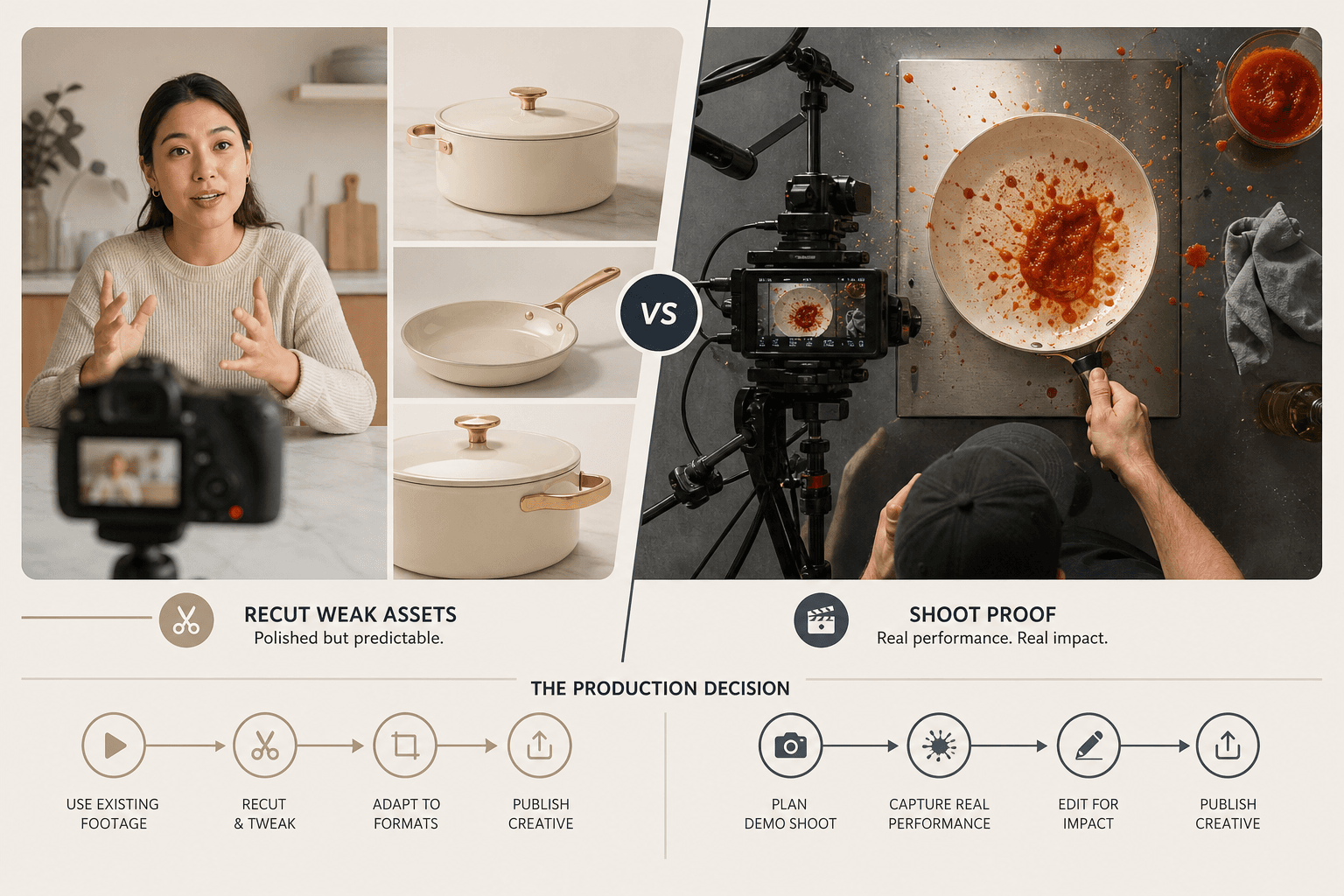
That distinction decides whether outside help will save time or just make the same problem look busier. If you already have solid source material and your team is stuck turning it into enough paid-ready versions for Facebook, Instagram, and TikTok, outsourcing ad creative editing can help. If the real gap is missing product proof, vague claims, or an approval process that turns every revision into archaeology, editing is not the fix.
That is the recommendation: outsource ad creative editing when post-production throughput is the constraint. Choose new footage, a tighter brief, or a cleaner approval path when the problem starts earlier.
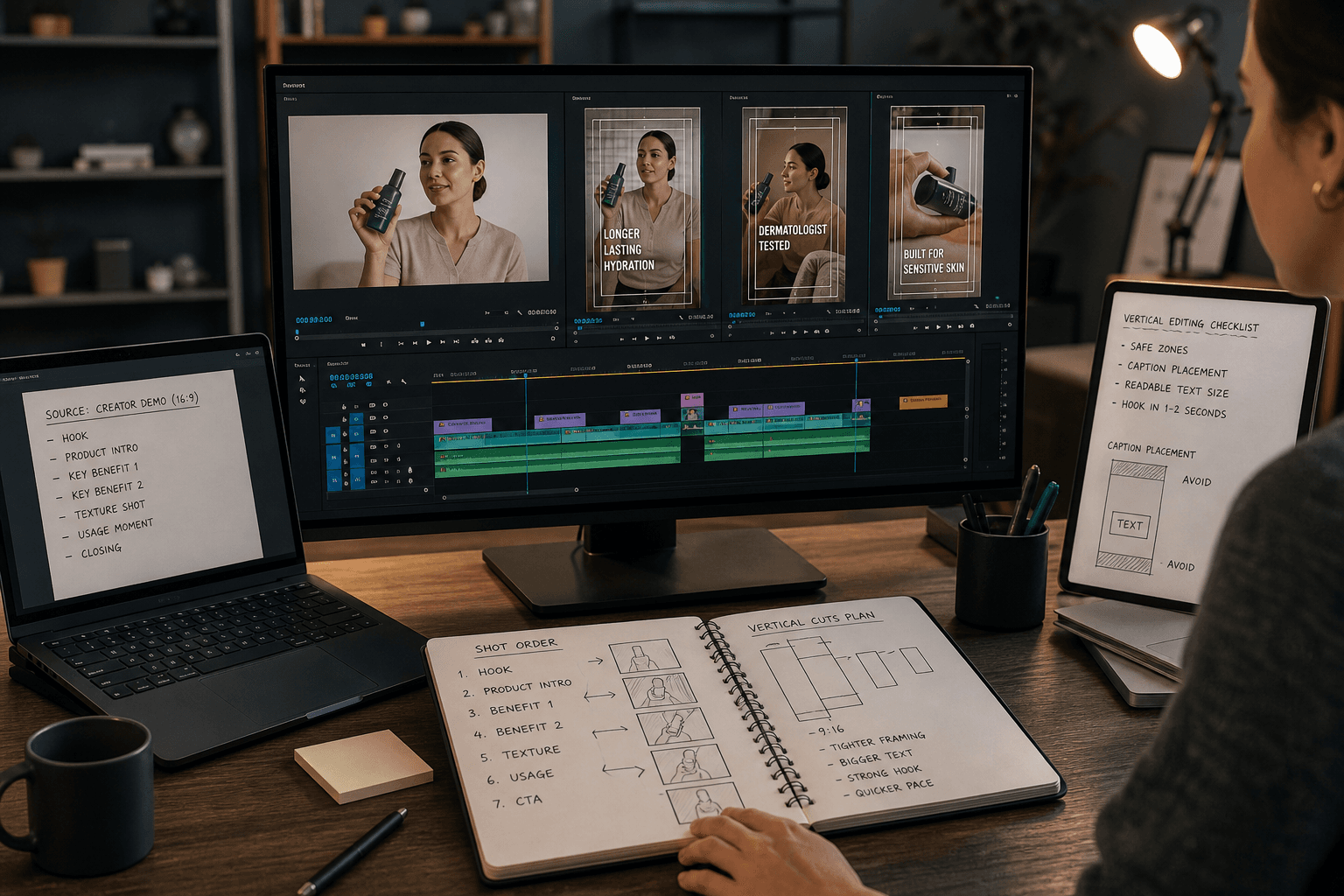
Platform guidance supports that split, but it has limits. Meta’s Reels guidance says businesses can use placement asset customisation and should account for 9:16 creative, audio, and safe zones for key messages in Reels placements, which makes resizing, reframing, and text placement real editing work according to Meta’s Reels ad guidance. TikTok’s ad preview tool similarly shows common vertical formats and a broad video duration range, while recommending shorter lengths such as 15 seconds for many ads according to TikTok’s ad preview guidance. What those sources do not show is that hiring an external editor will improve results on its own. They explain the production requirements, not the outcome.
Start by naming the bottleneck properly
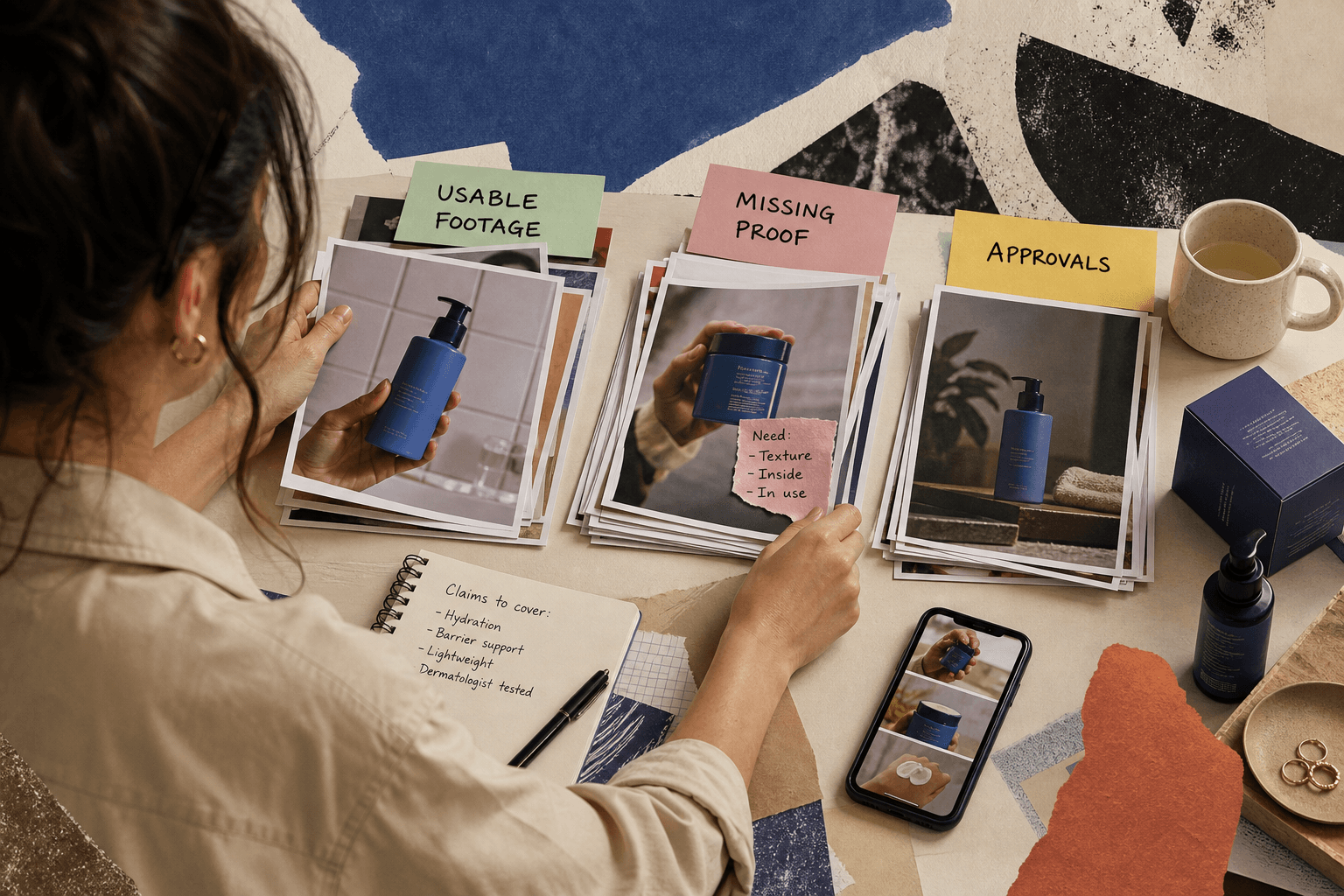
Before you commission anything, decide which of these is actually slowing paid creative down: editing, missing footage, or approvals.
If the team has good footage but cannot turn it into enough distinct cuts for testing, that is an editing problem. If every ad still feels weak because the product is never shown solving the problem, that is a footage problem. If cuts are ready but sit around waiting for legal, founder, or partner sign-off, that is an approvals problem.
You do not need a workshop for this. Look at the last three ads that actually launched and inspect what changed.
If the stronger version won because the opening line, crop, pace, or order of proof points improved, editing capacity is probably worth buying. If every version still lacked a clear demonstration, a believable use case, or a shot that answered the viewer’s first objection, more editing will not help much. If review cycles slipped because claims, partnership settings, or usage permissions were unresolved, then outside editing may only create faster files for a slower decision path.
That last issue is easy to underestimate. Instagram’s branded content rules require a paid partnership label when there is an exchange of value, including payment or gifted product, according to Instagram’s branded content help page. Meta also notes that promoting branded content can require creator permission through its workflow in Meta’s Reels ad guidance. An editor cannot fix missing permissions, however tasteful the captions are.
Read the video transcript
When ads feel stale, it’s tempting to ask for more variations. But if you only have one usable clip and no convincing proof, extra editing just multiplies the weakness. The decision gets simpler when you name what’s actually slowing launches: editing capacity, missing footage, or approvals. Outside editors help only when post-production is the part truly stuck. If the footage is solid, an editor can build useful versions by changing hooks, pacing, captions, crops, and order. Your team still has to own claims, offers, permissions, and sign-off. Imagine a magnesium lotion with approved, narrow claims and plenty of creator clips. An external editor could test routine-first against texture-first, because the proof already exists on camera. Start small with one concept and a few deliberate versions, so each change teaches something. If comments ask when to use it, add that context early instead of making random recuts. Editing can package a message, but it can’t invent the missing shot or clear disclosure issues. Buy outside editing when footage is strong; otherwise, fix proof or approvals first.
What an external editor should do, and what they should not be asked to do
An external editor is most useful when the team already has product truth, approved boundaries, and enough footage to support real variation rather than decorative recuts.
In that situation, outside editing can take on the operational work your internal team keeps postponing: hook variations, cutdowns, captioning, reframes for vertical placements, overlay changes, and versioning for different placements or audience angles. It can also make testing more disciplined if the brief is specific enough.
What should stay with your internal team is not glamorous, but it matters more. Keep product claims, offer choices, approval ownership, and launch context in-house. The editor should not decide what your product can promise, whether a discount angle works for your margins, or which legal language is non-negotiable. The editor can package the message. Your team still owns the message.
This is where many briefs drift into nonsense. “We need ten fresh ads” is not a brief. “Keep the demonstration and final offer card fixed; test three hooks and two first shots across TikTok and Reels placements” is a brief.
If you want those tests to tell you something useful, keep the change small enough to explain. Zagged’s guide on TikTok hook testing and what a controlled test should answer is worth reading before you brief an editor, because it forces one sensible question at a time instead of treating every new cut as a completely different ad.
Worked example: editing is the right thing to buy
Say you sell a magnesium lotion. You have 18 creator clips showing application, texture, packaging, and where the product fits in a night routine. You also have one founder explanation and one short macro sequence from a product shoot. Your buyer needs fresh paid creative for TikTok and Instagram Reels, and the claims are already narrow and approved: routine use, scent-free positioning, and visible texture. Nobody is trying to sneak a medical claim into the lower third at 6:45 p.m. That helps.
This is a good case for outsourcing ad creative editing because the footage can support genuinely different cuts.
A workable brief might read:
Objective: deliver six paid-social edits from existing footage for TikTok and Instagram Reels.
Keep fixed: approved claims, final offer card, visible application shot, product pack shot.
Test: first three seconds, order of routine steps, and caption density.
Avoid: any implication of guaranteed sleep outcomes or pain relief.
Two edit directions from the same source material could look like this.
Edit direction 1: routine-first
Shots: bedside table, creator picks up the lotion, applies it to shoulders, lamp turns off, product close-up.
Opening text: “Part of my night routine when I want less fuss.”
Decision note: use this when the account already responds to calming routine content and you do not need the opening to do heavy objection-handling.
Edit direction 2: texture-first
Shots: texture macro, quick application, creator says “not greasy,” bedside shot, pack shot.
Opening text: “If thick night lotions annoy you, watch the texture.”
Decision note: use this when prior comments or ad feedback show resistance to heavy-feeling body products.
Notice what the editor is changing. The angle, pace, order, and opening. Not the underlying product truth. Not the proof itself.
Now carry that same example one decision further. Say the texture-first edit holds attention better in the opening, but comments keep asking when to use the product. The next brief should not be “make more variations.” It should say:
Keep the texture opening. Add one on-screen line in the first five seconds explaining use context: “I use it right before bed.” Do not change the offer card or application shot.
That is what good outsourced editing looks like in practice. One round teaches you what to explain next. The finding changes the brief, not just the file count.
Worked example: the problem is missing proof, not editing capacity
Now imagine you sell a splatter guard for stovetop cooking. You have a clean founder monologue, product renders, and two tidy kitchen lifestyle clips. What you do not have is the shot that matters: hot oil hitting the guard instead of the stovetop.
If paid performance is flat, asking for “more ad editing” is the wrong diagnosis. The value of the product depends on visible proof. Faster cuts and louder captions cannot supply that proof after the fact.
Here is the wrong brief:
Need eight ad variations from existing assets. Test stronger hooks, faster pacing, and more text.
A competent editor can absolutely deliver that. You will then own eight versions of the same missing evidence.
Here is the better decision note:
Do not outsource editing alone yet. Commission new footage showing frying with and without the guard, plus the stovetop cleanup after cooking. Use the founder clip later as support, not as the main proof.
Once that footage exists, then an external editor becomes useful. One version can open on the splatter comparison for TikTok. Another can lead with cleanup convenience for Instagram Reels. A Facebook placement might keep the same demonstration but simplify the text and let the proof shot breathe longer.
The sequence matters. Proof first, recuts second.
If your conclusion is that you need creator-shot or product-use footage before editing can do its job, that is a broader production scope. Zagged’s human UGC service details are relevant in that narrower case because the public package includes a concept and hook, a real creator, editing and captions, a final video file, and paid and organic social usage, as described on Zagged’s UGC page. If you want a current price example, Zagged’s checkout listed 25–200 fully edited videos at $99 each with a $2,475 minimum order as of September 21, 2026 on the live UGC pricing page. That is Zagged’s offer, not an industry benchmark, and it does not tell you about revisions, raw footage access, exclusivity, or permissions, so those points should be confirmed in writing.
For comparing that broader scope with editing-only help, Zagged’s guide on ready-to-post UGC cost and what to compare besides price is useful because it shows how a cheaper quote can quietly create more internal work.
Approvals and disclosures can still be the real bottleneck
Sometimes the footage is good and the editing is fine, but the team still ships slowly because the ad has unresolved disclosure or labeling issues.
That matters on these platforms for different reasons. Instagram branded content requires the paid partnership label when there is an exchange of value, according to Instagram’s branded content rules. TikTok says realistic AI-generated or significantly AI-edited content must be labeled, and its ads system includes an AI-generated content disclaimer option according to TikTok’s AI-generated content policy and TikTok Ads Manager disclaimer guidance.
The practical implication is simple. If your workflow includes creator content, partner promotion, or AI-assisted variations, someone on the brand side must own that review. An editor can prepare the assets. They cannot settle whether the ad is correctly disclosed or permitted.
This is also where research usefully limits the advice. These platform sources tell you what has to be set up correctly. They do not tell you whether a branded-content ad will outperform a non-branded ad, whether AI-assisted creative is a smart brand choice, or whether a 15-second cut is inherently better than a 28-second one in your account. The sources define requirements and options. Your campaign data still has to answer the marketing question.
Run a paid pilot that tests fit, not fate
If you are going to outsource ad creative editing, do it with a small paid pilot. Not because pilots are fashionable, but because you need to learn whether the editor solves your actual production problem.
Use one concept with enough footage to support variation. Give the editor a fixed set of approved claims, a named placement plan, and a short explanation of what you want to learn. Then ask for a small set of cuts where each version has a reason to exist.
For example:
- Version A changes only the opening shot.
- Version B keeps the opening shot but changes the first line and caption density.
- Version C keeps the proof sequence but adapts framing and text placement for Reels safe zones.
- Version D keeps the same proof and offer but uses TikTok-style pacing and a shorter opening sentence.
What should you inspect after delivery and launch?
First, inspect whether the editor made meaningful versions or just cosmetic noise. If the only differences are font swaps and a trim here or there, the pilot did not really test editing fit.
Second, inspect whether approvals got simpler or messier. Did the cuts stay within the approved claim set? Did the team spend less time rewriting on-screen text? If not, the outside process may be adding another layer, not removing one.
Third, inspect whether any one change gave you a useful next step. For example, if the shorter opening line produced a cleaner first-three-second hold but the comments showed confusion about use context, the next brief should add context early while keeping the stronger opening structure. That is a production learning worth paying for.
If the pilot shows that your team still lacks the core proof shot, stop pretending the issue is post-production. Go get the footage.
If you want outside help adapting existing material into paid-ready variants, reviewing Zagged’s editing and production process is a reasonable next step. Bring the raw footage list, approved claims, placement plan, and one sentence describing the bottleneck. That sentence is half the decision.
Make the decision before you commission the work
Choose the sentence that is actually true this week.
If it is “we have good footage and need more paid-ready versions from it,” outsource ad creative editing.
If it is “we still do not have the shot that proves the product,” do not buy editing alone. Buy the missing proof first.
Ad creative editing handoff
Give an editor the material and decision behind a revision. Use this to separate a new hook test from a full creative rebuild.
Attach the actual source files and reference timecodes. If a claim needs new evidence or a missing shot, ask for it before editing around the gap.
See a completed example
- What this edit should help us learn
- Example: Does showing the product in use before the explanation make the opening easier to understand? This is a hypothesis, not a promised lift.
- Source files and selections
- Link the original footage, product shots, approved logo, captions and project files. Identify the exact takes or timecodes worth keeping.
- What stays consistent
- Keep the offer, body explanation and closing request consistent when comparing the opening. List any unavoidable differences.
- What changes in each version
- Version A opens on the product demonstration. Version B opens on the problem. Specify the visual and spoken change for each.
- Placement and export requirements
- List TikTok, Reels, Facebook or Shorts placements. Verify current aspect ratio, duration, safe-area and caption requirements for those placements.
- Claims, music and permissions
- Provide approved claims and cleared music. Identify footage with limited usage rights. Do not create an unsupported before-and-after result.
- Approval and file naming
- One approver; timestamped notes; a named revision round. Use product_opening-version_placement_date in filenames so the test can be traced.
Make your own brief
Your entries stay in this tab. Download before leaving; they are not saved or sent to Zagged.
Sources & further reading
- Instagram & Facebook Reels: Create Short Video Ads | Meta for Businessfacebook.com
- What is considered branded content | Instagram Help Centrefacebook.com
- Advertising on TikTok | TikTok Adsads.tiktok.com
- About AI-generated content | TikTok Supportsupport.tiktok.com
- About ad disclaimers in TikTok Ads Managerads.us.tiktok.com
- Zagged UGCzagged.com
- Zagged UGC pricingzagged.com
Published by Zagged Editorial. Examples are illustrative unless a source is identified. Updated .