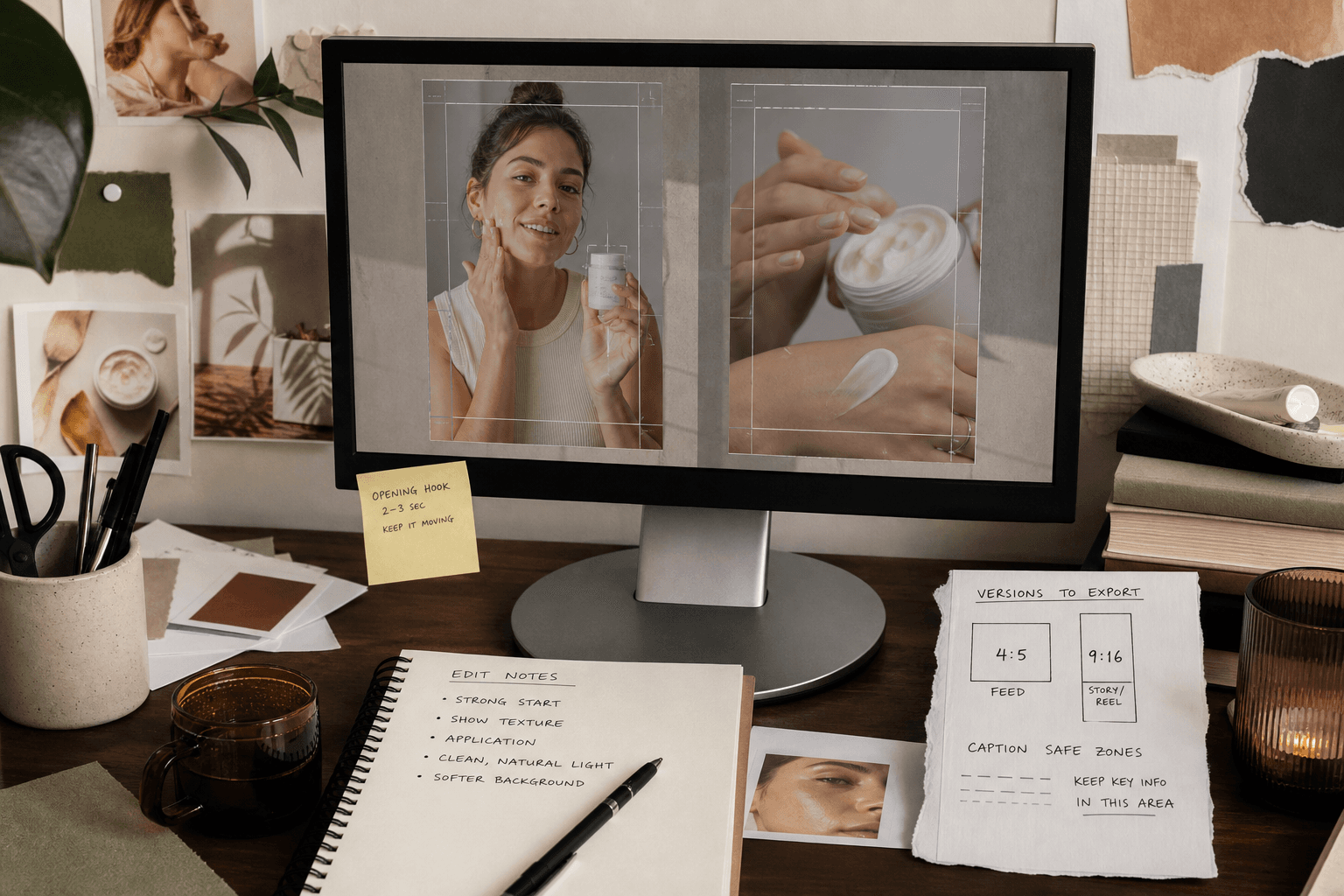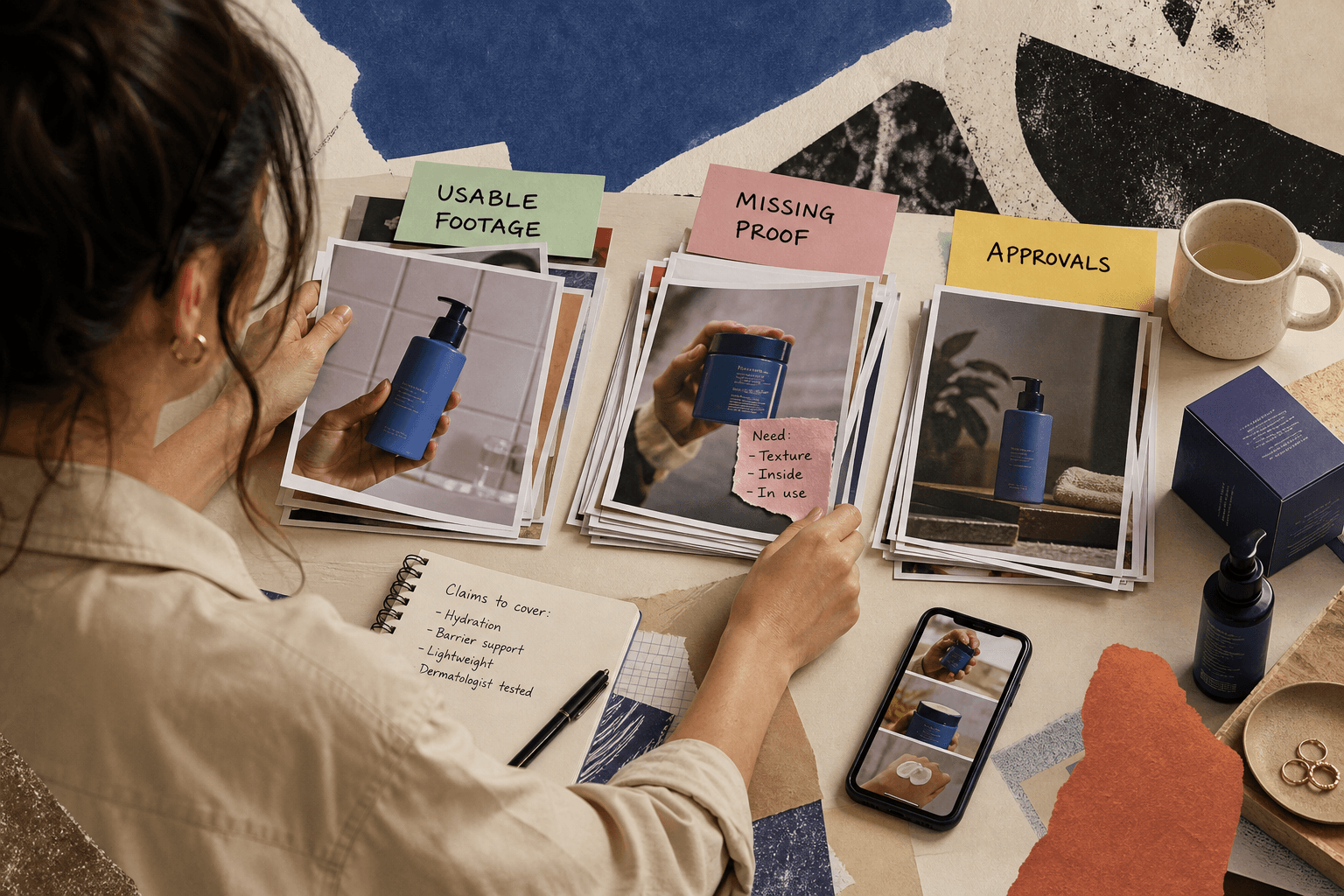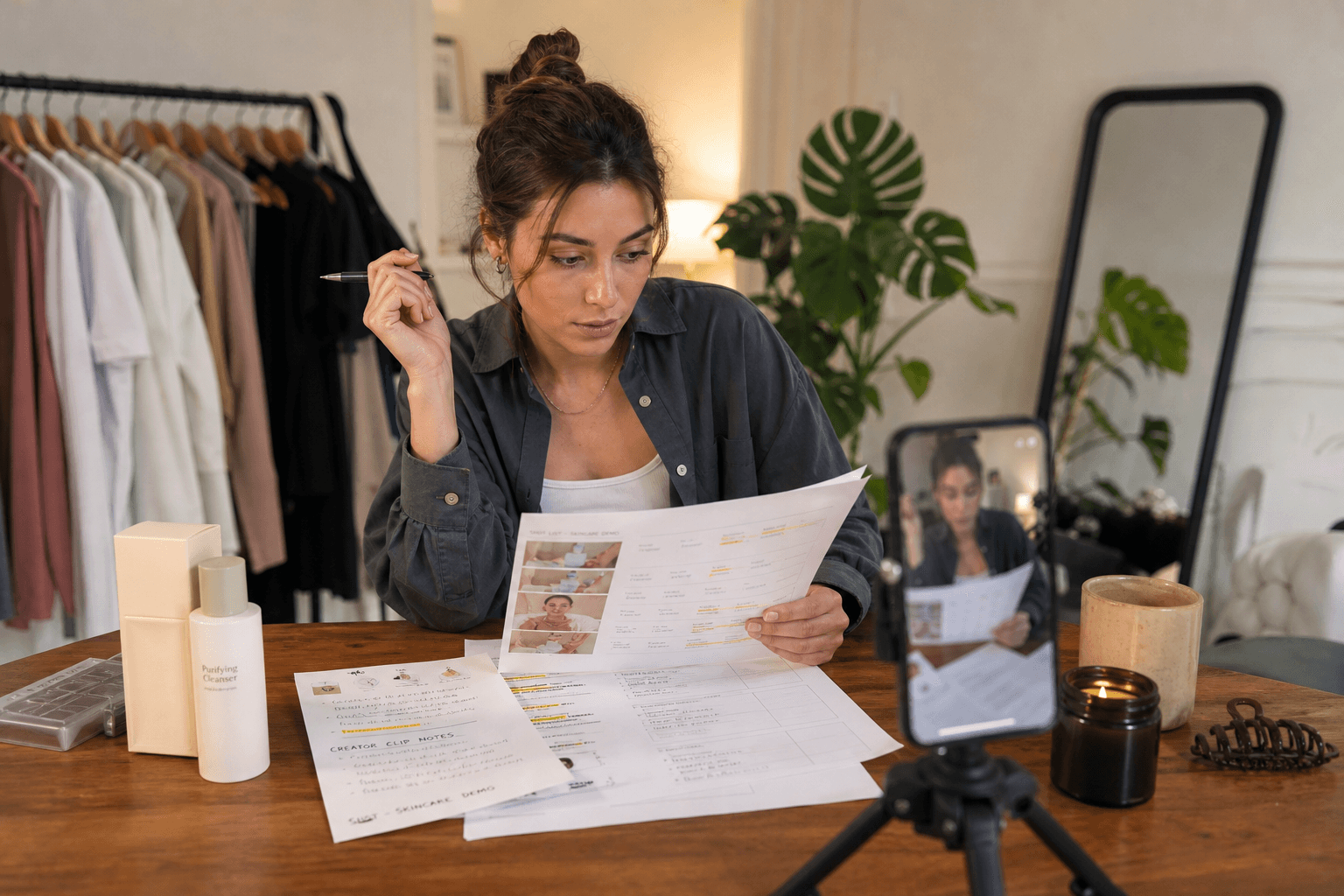
A common mistake is approving the cheapest editing quote, then learning that “editing” meant one cut, one ratio, no hook options, no caption treatment, and no help making uneven source footage usable.
That’s not really a pricing mistake. It’s a scope mistake.
If you’re comparing short-form video editing services this week, the useful question is not who is “best.” It’s which provider can turn the assets you already have into edits that fit the placements you actually plan to run on TikTok, Instagram or YouTube. The quote only starts to make sense after you pin down what footage exists, what the product truth is, who chooses the opening, how many variants you need, where the edit will run, and who absorbs revision churn.
For most lean ecommerce and consumer-brand teams, the recommendation is straightforward. Choose a lighter editing-only provider when your footage is already strong, your claims are approved, and someone in-house can direct revisions without slowing everything down. Choose broader support when the hard part is sorting mixed creator clips, old ads or founder footage into several paid-ready versions without creating a second full-time job for your team. Our guide on when to outsource ad creative editing is useful if you’re still deciding whether the real problem is editing capacity or missing proof in the footage.
“One edit” is not a comparable unit
Two providers can both sell “short-form editing” while pricing very different jobs.
One may assume you’ll provide selected clips, the exact hook, approved on-screen copy and one destination. Another may assume they need to watch all source footage, find usable moments, rebuild the first seconds, add captions, create variants and export for more than one placement. Both can put a neat number in a proposal. Only one may be quoting the job you actually need.
A better comparison uses the same criteria for every provider.
- Product truth: can the edit honestly show what the product is, does and doesn’t do?
- Input quality: are you supplying polished footage, rough creator clips, old ads, founder video, or mostly stills?
- Internal workload: who picks selects, writes hooks, checks claims and requests revisions?
- Iteration: are you buying one polished cut or several testable versions?
- Delivery scope: one export, or multiple crops, captions, cutdowns and variants?
- Intended placement: organic post, paid ad, or both?
That last point changes the recommendation more than buyers often admit. An organic Reel or TikTok can survive a looser shape if the creator’s voice carries it. Paid use usually needs tighter opening frames, more disciplined claim handling and cleaner version planning. If the same asset may move into paid later, decide that before kickoff, not after someone has already baked the subtitles into the wrong crop.
Read the video transcript
If you're comparing short-form editing quotes, the real headache isn't price alone. It's discovering too late that “editing” covered one basic cut, while your actual launch needed much more. A quote only means something once you know the footage, approved product truth, openings, placements, variants, and revision ownership. Those choices determine workload, so they change price. That matters because TikTok, Instagram, and YouTube aren't just different export boxes. Paid placements often need clearer first frames, safer copy, and planning that survives each platform's rules. Imagine a skincare team with forty mixed creator clips and three approved claims. Instead of asking who edits cheapest, they brief three paid-ready versions: problem-solution, routine, and ingredient explainer. When edits return, vague feedback wastes time. Check whether the first seconds explain the problem, the routine sequence makes sense, and the wording stays inside what footage honestly proves. Before kickoff, ask what's included: footage review, hook choices, captions, exports, variants, claim checks, and any AI disclosure responsibility. The best quote is the one pricing your real job.
Platform fit changes the job, not just the export settings
If a provider is quoting for TikTok, Instagram or YouTube, they should be able to explain what changes by platform without pretending the spec sheet can predict performance.
TikTok’s in-feed guidance recommends vertical 9:16 creative, supports several file types, allows 5 to 60 seconds, and recommends 9 to 15 seconds for that environment. TikTok also notes that safe zones change with caption length and add-ons, recommends using the preview tool, and says watermarks aren’t allowed in these placements (TikTok in-feed ad specifications). That does not tell you the perfect ad length for your brand. It does tell you a provider should be checking crops, overlays and readability for the actual placement instead of exporting once and declaring victory.
YouTube Shorts creates a different editing problem. Google recommends vertical 9:16 assets for Shorts ads, allows videos up to 3 minutes, but says only the first 60 seconds play in the Shorts feed and recommends videos under 60 seconds for that environment (YouTube Shorts ads specs and best practices). Google’s broader video specs also support common vertical ad dimensions and accepted formats for video campaigns (Google Ads video specs and format requirements). That means a provider offering “Shorts editing” should be talking about whether the first minute stands alone, not just whether they can crop horizontal footage.
Instagram brings a different decision when creator-made assets are involved. Meta says branded content featuring or influenced by a business partner in exchange for value requires the paid partnership label (Instagram branded content guidance). That’s not a style note. It affects workflow, permissions and approval timing if creator-made content may be used in paid media.
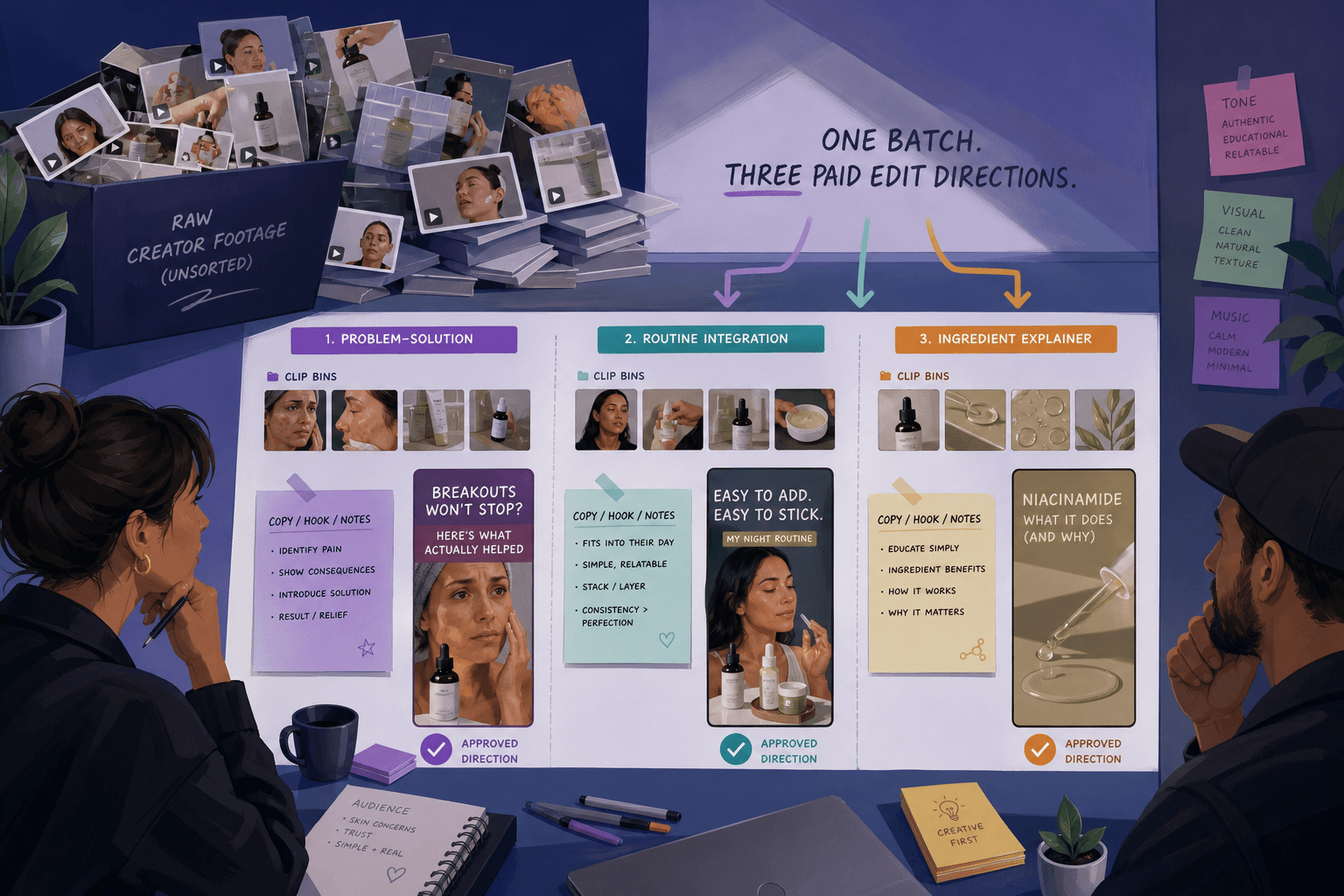
Worked example: too much skincare footage, not enough time
Say you sell skincare and have 40 raw creator clips from different contributors. Some are clean. Some are dim. Some are enthusiastic in ways legal would not enjoy. You have three approved claims and want paid tests on TikTok and Instagram.
The wrong question is, “Who can edit these cheapest?”
The useful question is, “Who can turn this pile into a few claim-safe variants without sending our team into a revision swamp?”
A brief note worth sending might look like this:
Product: gel cleanser for oily skin
Approved truth to show: texture, lather, rinse-off, place in routine
Do not imply: acne treatment, guaranteed outcome, overnight transformation
Need: three opening approaches from existing footage
Placements: TikTok paid, Instagram paid
Deliverable logic: one problem/solution cut, one routine integration cut, one ingredient explainer cut
Now you can compare providers on the actual work.
For the first cut, a problem/solution version, the opening might use a shiny forehead close-up, then the pump and sink rinse, with on-screen text such as: “Midday shine again?” The edit note here is simple: move quickly at the start, then slow down enough to show texture honestly.
For the second cut, a routine integration version, the opening could show the cleanser at the sink next to other routine items, with copy like: “What I use first when my skin feels greasy.” The edit should make the order of use easy to follow rather than cramming every benefit into the first four seconds.
For the third cut, an ingredient explainer, the opening might show product in hand, then a lather demonstration, with wording such as: “Why this cleanser feels light, not stripping.” This one needs tighter copy review because explanatory language can drift into claims the footage doesn’t prove.
The editing software is not the point here. Editorial judgment is.
A cheaper editing-only provider may still be the right buy if your team can supply selects, approved copy and exact structure. If your team needs the editor to decide which clips become the routine version, which become the explainer, and what to cut when a creator overstates the product, that belongs in scope and in price.
If you decide the footage itself is the problem, not just the assembly, don’t keep paying editors to disguise that fact. Our piece on what to change before reshooting ad creative is useful at that point because it draws the line between clarifying existing proof and trying to invent proof that isn’t there.
Review the returned edit by decision, not by vibe
When those skincare edits come back, don’t review them with vague comments like “Can we make it pop more?” Nobody benefits from that sentence.
Inspect what would change the next decision.
For the problem/solution version, watch the first two seconds with the sound off. Can you tell what the problem is and what type of product is being shown? If not, ask for a clearer first frame or better shot order.
For the routine version, inspect whether the pacing lets a viewer understand sequence. If the cleanser appears and vanishes before anyone can register where it fits, the edit is hurting belief, not helping it.
For the ingredient explainer, compare the copy against the footage. If the video can honestly show texture, lather and routine use, keep the text there. If the wording starts implying outcomes the footage can’t support, pull it back.
This is also where controlled variation matters. Our guide on TikTok hook testing explains the point well: change one thing you can learn from. If one version changes the hook, pacing, CTA, captions and shot order all at once, the result may tell you one ad beat another, but not what to brief next.
Worked example: founder footage that doesn’t magically become Shorts
Now take a different case. Imagine a supplement brand with polished 16:9 founder videos originally made for YouTube. The team wants YouTube Shorts ads and a few TikTok tests without reshooting yet.
A weak provider response is: “We’ll just crop it vertical.”
A better response is: “We can test whether this survives vertical restructuring, but the first 60 seconds need to work on their own for Shorts, and some horizontal framing may not crop cleanly.”
That answer is more credible because it matches the actual platform environment Google describes for Shorts ads (YouTube Shorts ads specs and best practices). It still doesn’t guarantee performance. It just shows the provider understands the constraint.
A sensible edit note might look like this:
Source asset: four-minute founder explanation shot for horizontal YouTube
Goal: three vertical cuts under 60 seconds for Shorts testing
Keep: founder authority, product-in-hand moments, one supporting caption line
Remove: long preamble, sponsor-style intro, side tangents
Watch for: headroom after crop, packaging readability, whether claims still sound responsible when compressed
Three possible outputs could follow.
Cut A opens on the founder saying, “Most people use this at the wrong point in the day,” then shows the product by second three.
Cut B opens on the product in routine context with on-screen text: “Where this actually fits in your day.”
Cut C opens on a myth correction such as, “This isn’t a replacement for meals,” but only if that line is relevant and already approved.
Now carry the decision one step further. If the vertical crop keeps cutting off the product, if the founder’s authority depends on a long setup, or if the proof lives in demonstrations you don’t actually have, the honest answer may be reshooting. Editing is not a witness protection program for weak source material.
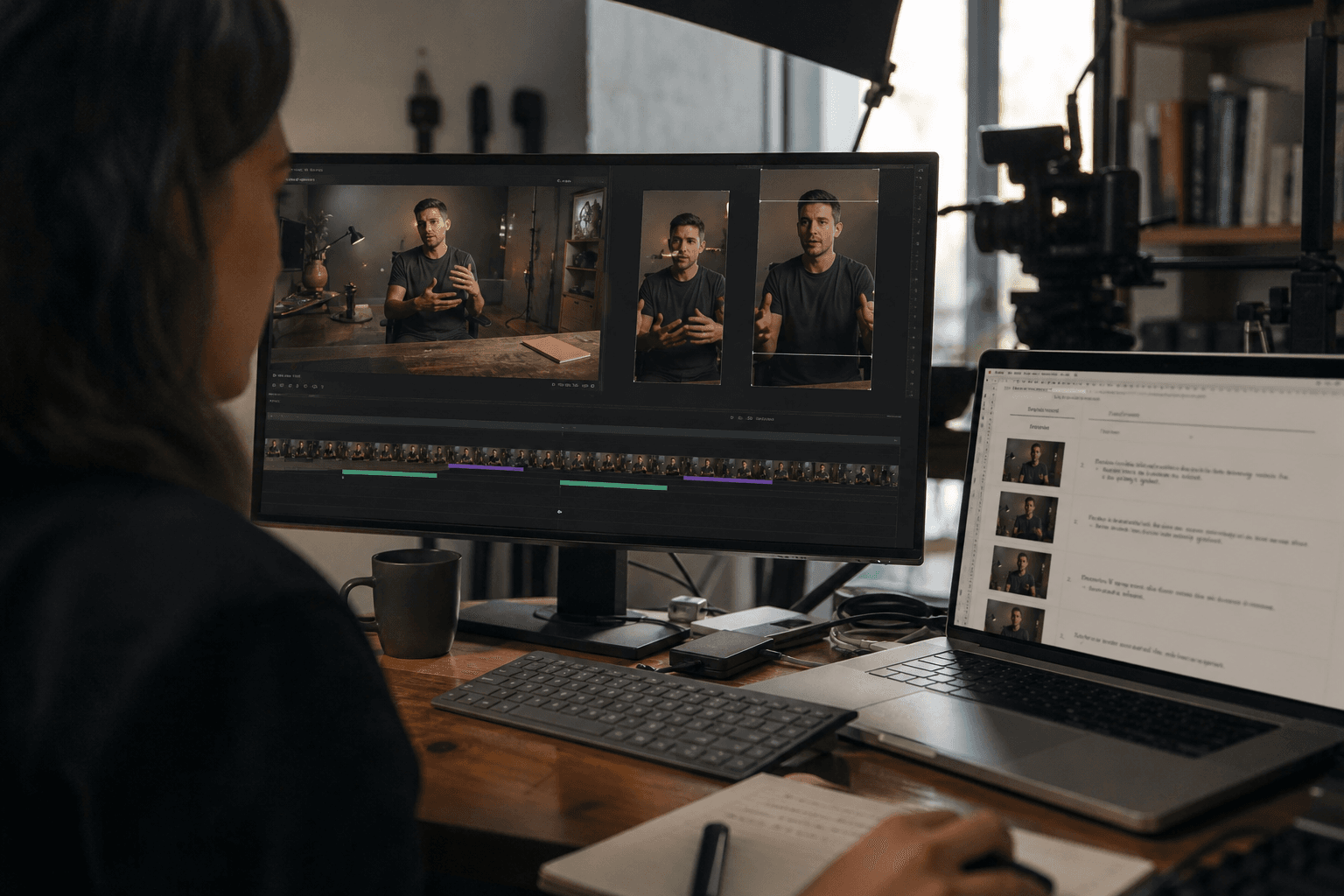
Don’t let a highlight reel answer the wrong question
Most editing portfolios are good at showing taste. They are much less reliable at showing scope.
When you review relevant work, ask what happened before the timeline. Was the footage already clean, or did the editor have to rescue uneven creator submissions? Did they shape the hook and story, or just execute a locked brief? Is the sample one polished hero cut, or part of a test system with multiple variants? Do the edits show believable product use, or mainly pace tricks and typography?
If your shortlist includes providers that also source creators or package creator-led content, separate creator fit from editing fit. Our guide to evaluating UGC creator fit helps here because a creator can be convincing on camera and still need heavy editorial support afterward.
Zagged’s public human UGC service details are a good example of why this distinction matters. That offer includes a concept and hook, a real creator, editing and captions, a final video file, and paid or organic social usage. As of October 2026, the live order flow shows 25 to 200 fully edited videos at USD $99 each, with a USD $2,475 minimum order (live UGC pricing offer). That is a specific Zagged offer, not an industry benchmark. The useful lesson is simply that some quotes include creator input and concepting while others assume you will provide all of that yourself.
Ask about AI handling before it becomes a cleanup job
This is no longer a niche question.
Google says certain AI-generated or AI-edited assets may require disclosures or labels in some jurisdictions, and provides AI label settings in ad tools (YouTube Shorts ads specs and best practices). Meta says labels may appear when ad images or video are created or significantly edited with its generative AI features, and it is expanding detection of third-party AI signals (Meta GenAI transparency update). TikTok separately maintains its own rules for AI-generated content on the platform (TikTok AI-generated content rules).
The decision this changes is specific. Ask whether the provider plans to use AI generation or significant AI-assisted alteration, and ask who is responsible for disclosure review before publishing. A normal edit with cuts and captions is not the same thing as generating a synthetic person or materially changing what appears on screen. The platforms do not use identical rules, so don’t assume one policy carries neatly across the others.
That also means you should name the service you’re buying accurately. Human UGC and AI-generated creative are different offers. If you need a real creator actually demonstrating a product, say that plainly. If you want AI-assisted concept variation or synthetic assets, say that plainly too.
The approval question to send back before kickoff
Before you approve a provider, send one direct note that forces scope into daylight.
You can use wording like this:
Please confirm whether this quote includes source-footage review, hook selection, on-screen copy drafting, caption styling, platform-specific exports and multiple test variants, or only one master edit. Please also confirm which placements these edits are intended for: TikTok paid or organic, Instagram paid or organic, YouTube Shorts organic or Shorts ads. Finally, confirm who is responsible for claim review, branded-content workflow where relevant, and any AI-related disclosure checks.
That message usually does more than a second round of sales calls.
If the reply shows you already own the footage quality, hook, claims and approvals, an editing-only provider may be enough. If the reply reveals that nobody owns triage, versioning, placement QA or paid-use readiness, then the cheapest quote was never solving the problem.
If you need support beyond straight editing, have a look at Zagged’s production process for editing and versioning. If you’re already comparing a defined scope and want to discuss it, a short note through the project contact page is enough. Bring the intended placements, source assets and approval constraints. That will make the conversation faster than asking for a generic rate card.
Your next move is not collecting more quotes. It’s making sure every quote is pricing the same job.
Ad creative editing handoff
Give an editor the material and decision behind a revision. Use this to separate a new hook test from a full creative rebuild.
Attach the actual source files and reference timecodes. If a claim needs new evidence or a missing shot, ask for it before editing around the gap.
See a completed example
- What this edit should help us learn
- Example: Does showing the product in use before the explanation make the opening easier to understand? This is a hypothesis, not a promised lift.
- Source files and selections
- Link the original footage, product shots, approved logo, captions and project files. Identify the exact takes or timecodes worth keeping.
- What stays consistent
- Keep the offer, body explanation and closing request consistent when comparing the opening. List any unavoidable differences.
- What changes in each version
- Version A opens on the product demonstration. Version B opens on the problem. Specify the visual and spoken change for each.
- Placement and export requirements
- List TikTok, Reels, Facebook or Shorts placements. Verify current aspect ratio, duration, safe-area and caption requirements for those placements.
- Claims, music and permissions
- Provide approved claims and cleared music. Identify footage with limited usage rights. Do not create an unsupported before-and-after result.
- Approval and file naming
- One approver; timestamped notes; a named revision round. Use product_opening-version_placement_date in filenames so the test can be traced.
Make your own brief
Your entries stay in this tab. Download before leaving; they are not saved or sent to Zagged.
Sources & further reading
- TikTok reservation in-feed ad specificationsads.tiktok.com
- YouTube Shorts ads: Asset specs and best practicessupport.google.com
- Video ads specs and format requirementssupport.google.com
- Instagram branded content guidancefacebook.com
- Meta GenAI transparency for ads productsabout.fb.com
- TikTok AI-generated content rulessupport.tiktok.com
- Zagged human UGC offerzagged.com
- Zagged UGC pricingzagged.com
Published by Zagged Editorial. Updated .