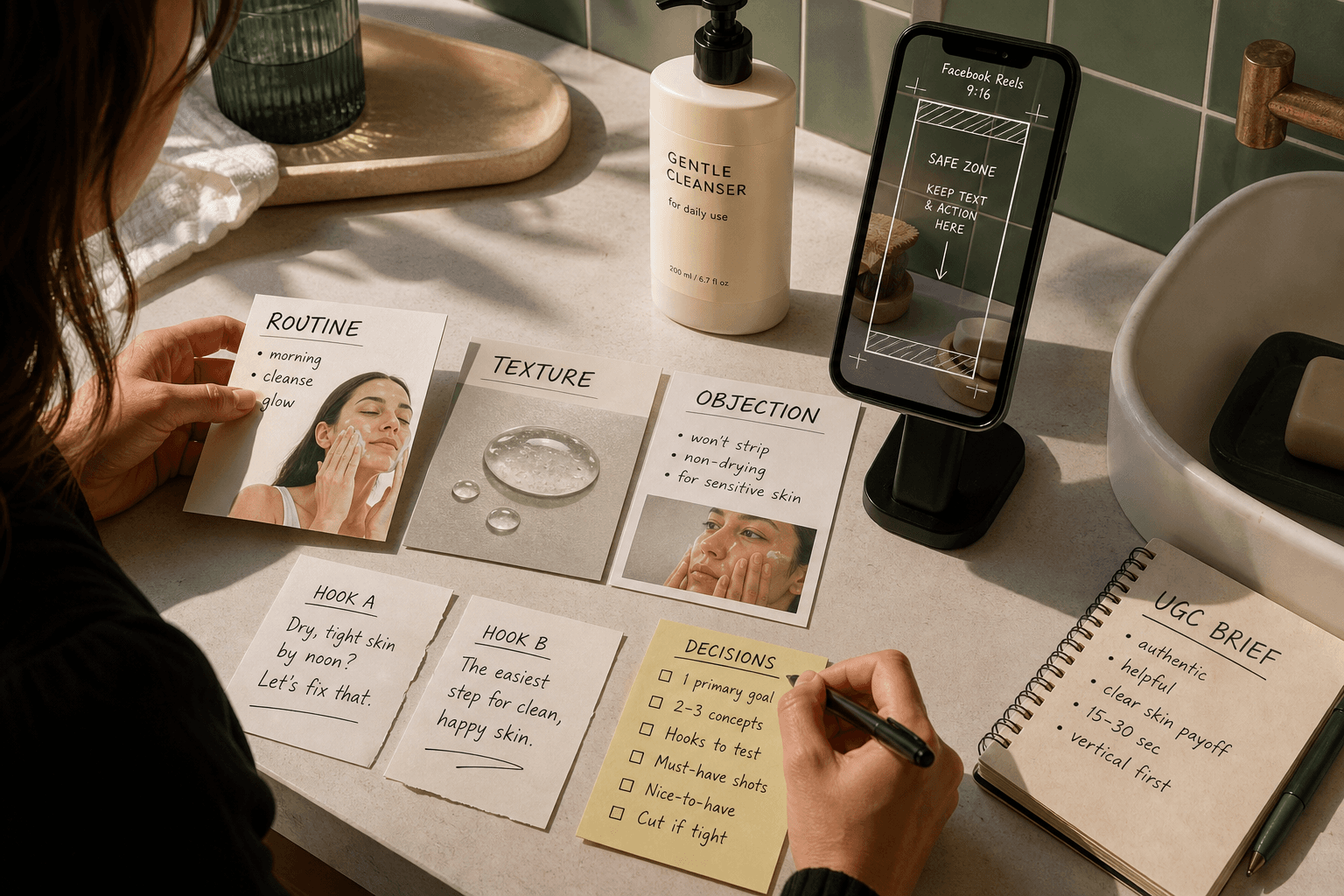
The expensive mistake is assigning Facebook Reels like this: “We need three this week.” That sounds decisive until someone has to brief the work, approve the cut, and explain why the videos were busy without being useful.
A better Facebook Reels content strategy starts one step earlier. Ask what customers keep needing help with before they buy, while they compare options, or right after the product arrives. Then make each Reel answer one of those questions with proof the viewer can actually see.
That recommendation is less glamorous than trend-chasing, but it is easier to run. Questions create briefs. Trends create a lot of vague enthusiasm and, quite often, rework.
This also fits how Facebook works. Meta says recommendation and ranking systems shape experiences across Facebook and Instagram, including Reels, so your video may be shown to people who do not already know your Page (Meta system cards overview; Meta on how AI powers Facebook and Instagram experiences). That does not prove that question-led creative will beat every other approach. It does support a practical production decision: each Reel has to make sense quickly on its own, without relying on audience familiarity or a wider series people may never see.
The choice to make: source topics from questions or from trends
For most lean consumer brands, source topics from customer questions and use trends, if at all, as packaging. Choose differently only when your team already has native entertainment instincts, fast approvals, and enough publishing capacity to react while a format still feels current.
Why this usually works better is simple. A question tells the team what the video is responsible for. It narrows the claim, the footage, and the approval standard.
“Answer whether this pan works on induction” is a brief.
“Make a fun Reel for Facebook” is an invitation to spend money finding out no one agreed on the job.
This is the same planning logic behind our guide on an organic social media strategy your team can keep improving: choose a recurring customer problem, give each format a job, and improve the next brief from what people actually responded to. For Facebook Reels, the useful jobs are usually narrower than “build awareness.” They are things like removing confusion, handling an objection, showing setup, proving compatibility, or helping the buyer picture ownership.
Trend-led production deserves more room when the product is obvious on sight and the audience does not need much explanation. A novelty snack, a visually satisfying household gadget, or a fashion item with clear visual payoff can support more entertainment-led work. Even then, the team still needs a point of view about what the viewer is noticing, not just a sound clip and a prayer.
Read the video transcript
If your team keeps saying, “We need more Reels,” the work can get expensive fast, because nobody really knows what each video must help a viewer understand. A stronger plan begins with questions customers already ask before buying or after delivery, because one clear question gives the footage, script, and review process a real job. Trend-led ideas can create enthusiasm, but question-led briefs usually run better for lean brands, especially when Facebook may show a Reel to people unfamiliar with you. Imagine a skincare brand hearing, “What goes first?” One Reel simply shows the routine in order, with each product visible, so confused shoppers can picture using it. For the next assignment, name the exact question, the approved answer, and the proof needed on screen; keep captions and subtitles clear inside Facebook-safe areas. This won’t guarantee question-led Reels beat every other approach, but it does make videos understandable on their own and easier to improve from comment patterns.
Why Facebook changes the assignment
A Facebook Reel should not be approved as a simple repost from TikTok or Instagram.
Meta’s own caption guidance says Facebook can support more description than Instagram, while still benefiting from concise writing, and recommends captions that encourage comments and shares (Meta caption guidance). That does not mean every Facebook caption should become a small essay. It does mean a customer-question Reel on Facebook can use the caption to restate the question, add one clarifying point, and invite a useful reply.
For example, if the Reel shows routine order for a skincare set, a workable Facebook caption is:
“Can you use these in the same routine, and what goes first? Here’s the order shown step by step from the product directions. If your routine gets confusing at one step, tell us which one.”
That is not trying to be clever. Good. Cleverness is often how useful information gets edited out.
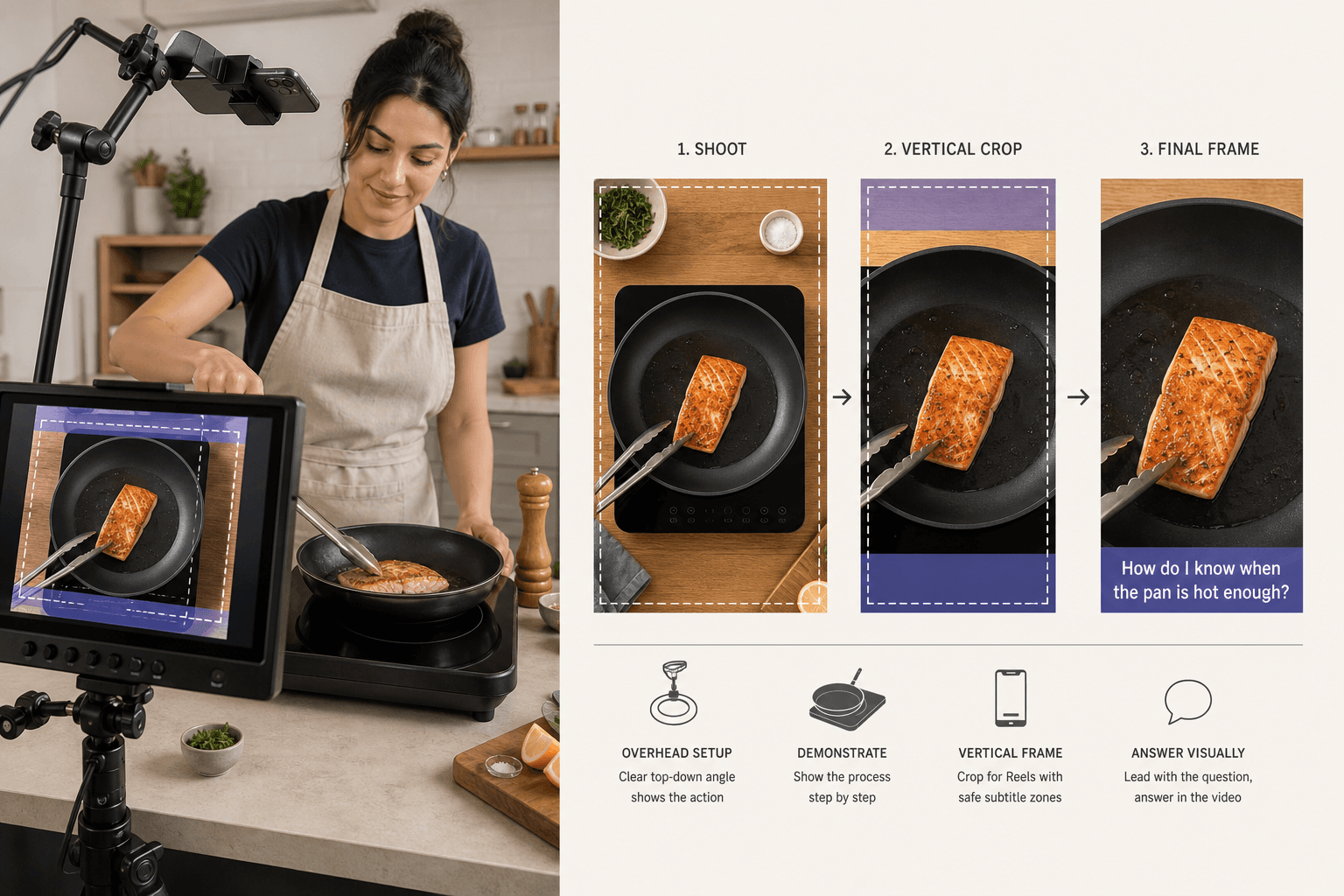
Facebook packaging also affects the edit itself. Meta developer guidance says core elements for Stories and Reels should stay inside the safe zone (Meta developer guidance on safe placement for Stories and Reels). So if the spoken answer, subtitles, product label, or proof shot sits too low or too close to interface areas, the Reel can fail even when the underlying footage is fine.
That requirement should show up in the brief, not as an irritated note after the first cut comes back.
Build the assignment from question, proof, and format
A sustainable Facebook Reels plan is usually built in four moves.
First, gather the questions. Pull them from support inboxes, product page chat, comments, reviews, founder DMs, retail partner feedback, and post-purchase confusion. The best topics are the questions your team is already answering repeatedly.
Second, group those questions by stage. Before-purchase questions often deal with comparison, fit, trust, compatibility, or whether the product will solve the right problem. Post-purchase questions usually point to setup friction, routine order, care, cleanup, or expectation gaps. Both matter. If a new customer is confused after delivery, a prospective customer may be worried about the same thing.
Third, decide what proof the video needs. Some questions can be answered with straightforward explanation and product closeups. Others need visible demonstration. If the product claim depends on texture, fit, motion, sequence, cleanup, size, or compatibility, choose a format that can honestly show that.
Fourth, choose the lightest truthful format. Not every question needs creator-led video. Some need a hands-only demo. Some can work as a slideshow built from strong stills and precise copy. If you are deciding whether a sequence should stay visual and explanatory rather than becoming a forced video, our guide on buying social slideshow production by comparing the editorial work, not just the slides is useful for that production call.
Worked example: skincare routine questions
Say you sell a skincare line and your team keeps seeing two questions: “Can I use this with retinol?” and “What order do I apply these in?”
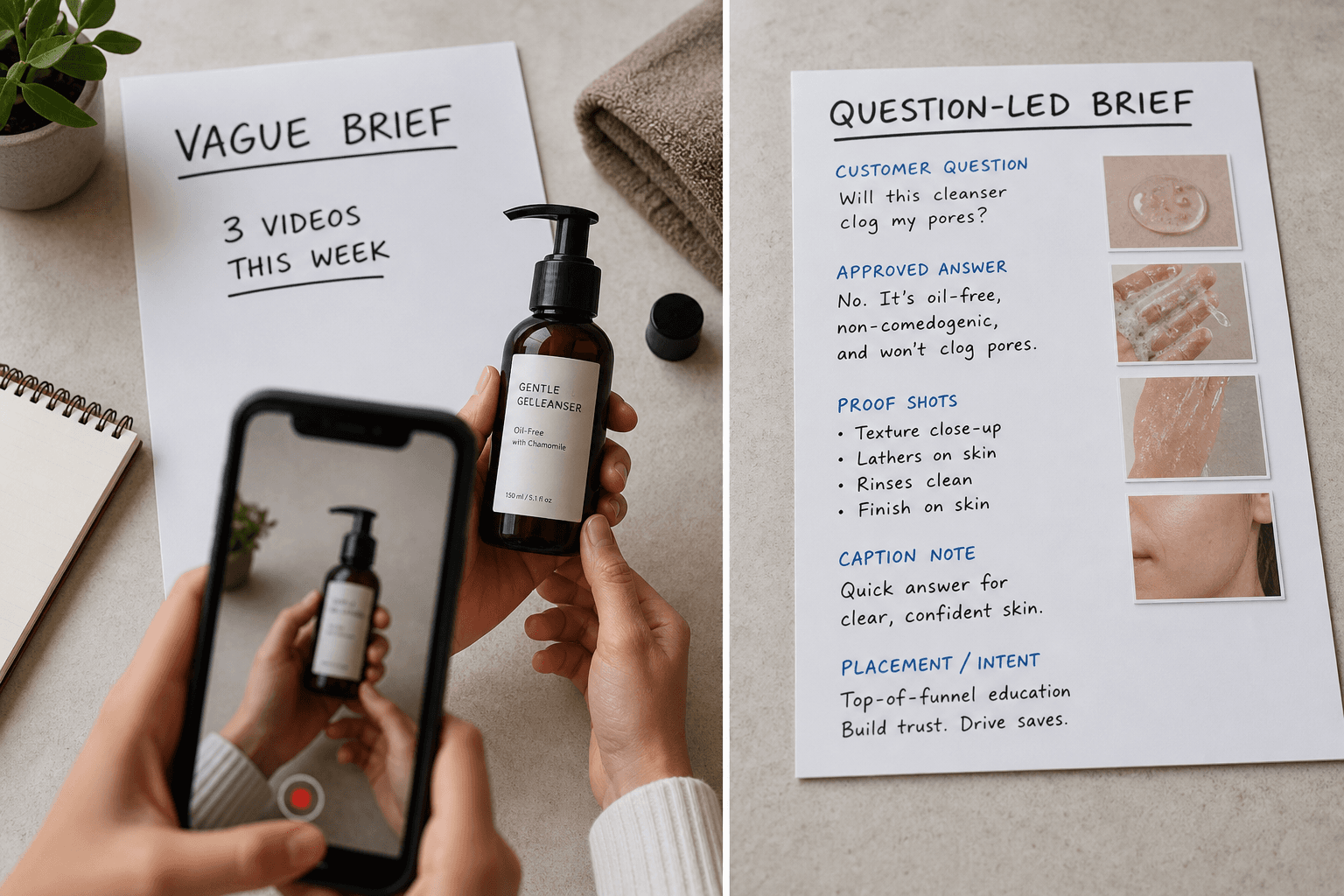
The weak assignment is “make three educational Reels.” Nobody knows what that means until it is too late.
The stronger assignment is narrower:
- one Reel on routine order
- one Reel on compatibility, with careful wording
- one Reel on who the product is for and where to check instructions first
Start with the routine-order Reel.
Decision note: This Reel answers one question only: what goes first, second, and third. It should not smuggle in extra claims about results.
Working opening line: “Here’s the order if you’ve been staring at the shelf wondering what goes first.”
Shot sequence:
- all products visible together in the opening frame
- hand picks up the first product with on-screen text such as “Step 1”
- quick texture or application shot
- repeat for the remaining steps
- final frame returns to the full routine in order
Edit instruction: Keep subtitles high enough to survive Facebook Reel interface elements, and do not let the product names disappear under captions.
Caption wording for Facebook: “If your routine order keeps changing depending on which video you watched last, start here. This shows the sequence from first step to last. Which step do you usually get stuck on?”
Now carry the same example into the harder question: retinol compatibility.
This is where teams often create approval trouble for themselves by making a neat, confident statement where the truth is qualified.
Decision note: If the approved guidance is conditional, keep the condition in the script. Speed is not a good reason to become inaccurate.
Possible opening line: “Can these sit in the same routine as retinol? Sometimes, but the order and product directions matter.”
Shot sequence:
- creator or hands holding both relevant products
- text card stating “Check your product directions first”
- simple sequence showing where each product would sit
- close shot of packaging or directions if that helps the viewer verify the answer
Approval standard: If removing one sentence would turn the answer into an overclaim, that sentence stays.
If you need creator-led footage for this kind of explanation, Zagged’s human UGC service with real creators is the relevant offer. The public offer says it includes a concept and hook, a real creator, editing and captions, a final video file, and paid or organic social usage. The live checkout currently lists 50–200 fully edited videos at $99 each, with a $4,950 minimum order as of November 2026 (Zagged UGC offer; Zagged UGC pricing). Those are Zagged’s offer details, not an industry benchmark. Confirm scope items like revisions, raw footage, and rights specifics in writing before buying.
Worked example: cookware questions with visible proof
Imagine you sell cookware and the repeated questions are “Will this work on induction?” and “How hard is cleanup really?”
These are good Facebook Reel topics because the proof can appear on camera early.
For induction compatibility, the brief should lead with proof rather than explanation.
Opening shot: Pan placed on the induction surface with immediate visible response.
Opening line: “If you’re checking whether this works on induction, this is the part worth seeing first.”
Middle sequence:
- overhead angle showing the pan in use
- tight crop on the cooktop and the pan base
- on-screen text only if the exact compatibility wording is approved
Edit note: Do not spend the first three seconds on a person talking about compatibility if the compatibility itself can be shown faster.
Caption wording for Facebook: “The quickest answer to the induction question is to show it. If you cook across more than one stovetop type, what compatibility detail do you usually check first?”
Now the cleanup Reel.
Opening shot: The used pan, not a pristine hero shot pretending the cooking already happened somewhere off camera.
Opening line: “Cleanup claims are cheap, so here’s what this looks like after use.”
Middle sequence:
- rinse
- wipe or scrub as appropriate
- final surface shot
Approval note: If cleanup only looks easy under a specific condition, say that. “After eggs on medium heat” is more believable than a vague miracle.
This example also helps with a second production decision. Sometimes the problem is not ideation. It is footage backlog. If your team already has founder demos, support videos, product explainers, or long-form footage that contains useful answers, clipping and repurposing may be the smarter buy than net-new production. In that case, use Clippin. Our guide on what makes a clipping service worth hiring can help you decide whether the real bottleneck is edit volume or weak source material.
What a production partner needs from you
If you outsource Facebook Reels production, hand over the inputs that keep the work truthful and reviewable.
At minimum, the partner needs the exact question each Reel is answering, the approved answer or claims boundary, the proof that must appear on screen, the assets available to show it, and where the finished Reel may run.
That last point matters more than teams sometimes expect. Organic Page posting and paid placement are not the same assignment. Meta has broadened its labeling approach for AI-generated or AI-edited content under “AI info,” and Meta has also described transparency steps for ads products using generative AI features (Meta on AI labeling approach; Meta ads transparency note via PublicNow). Those sources do not tell you that AI creative will perform better or worse. They do inform a simpler decision: settle early whether the Reel is organic only, likely to be used in ads, or built for both, then confirm what disclosures apply.
Also worth stating plainly: human UGC and AI-generated creative are different tools. Do not present a synthetic person as a real customer or imply real product use that did not happen.
If your team already knows the recurring questions but needs help turning them into ongoing research, briefs, production, distribution, and iteration, Zagged’s organic social production and distribution process is the relevant service path.
How to approve a Facebook Reel without drifting into taste debates
Approve the Reel against its job, not against a general feeling that it seems native.
Start with three checks.
First, inspect the opening frame and first line. Do they state or clearly imply the customer question? If not, change the opening. Do not hope viewers will patiently wait for the point.
Second, inspect the proof. Is the answer visible, or is the video mostly asserting something? If people would still need to take your word for it, you may need different footage, a slower sequence, or a different format entirely.
Third, inspect the Facebook packaging. Are subtitles readable inside safe areas? Does the caption add the missing context instead of pasting in a TikTok-style one-liner? Does the comments prompt invite a response that teaches you something useful?
That last part matters because “look at performance” is too vague to help the next assignment. Look instead at what people are still asking in comments, where they sound confused, and which questions keep resurfacing across several Reels. If the routine-order Reel gets repeated comments like “Does this change if I use retinol at night?” your next brief should answer that specific follow-up. If the induction Reel gets comments asking about glass-top stoves, the next decision is obvious enough that even a committee should be able to spot it.
When to keep Facebook Reels in-house
Keep this work in-house when your team can already do four things reliably: gather recurring questions, protect claims accuracy, source or shoot usable proof, and maintain a repeatable publishing rhythm.
Outsource when the hard part is sustained production rather than strategy theatre. That usually means your team knows the product truth and the recurring questions, but lacks capacity to turn them into regular briefs, edits, captions, and distribution decisions without clogging up the week.
If you already have strong source footage and the message is settled, a narrower editing or repurposing scope may be enough. If you do not yet have believable proof on camera, outsourcing editing alone will not magically produce it. The footage remains, regrettably, the footage.
Pull the last 20 customer questions your team has answered about the product. Circle the five that affect buying most often. Then assign three Facebook Reels that each answer one question with visible proof and Facebook-safe packaging. That is a better production brief than “we need more short-form,” and a much better way to find out what your Facebook program actually needs next.
Sources & further reading
- Introducing 22 system cards that explain how AI powers experiences on Facebook and Instagramai.meta.com
- System Cards - Meta AIai.meta.com
- How to Write Social Media Captions with AI | Meta AIai.meta.com
- Understanding and optimizing your ad campaign | Meta Horizon OS Developersdevelopers.meta.com
- Our Approach to Labeling AI-Generated Content and Manipulated Mediaabout.fb.com
- Expanding GenAI Transparency for Meta’s Ads Productspublicnow.com
- Zagged organic social processzagged.com
- Zagged UGCzagged.com
- Zagged UGC pricingzagged.com
- Clippinclippin.com
Published by Zagged Editorial. Updated .