
The calendar is full, but the team still has the same conversation every Monday: what are we posting this week?
That can happen even when everyone is working hard. A trend fills one slot, a product photograph fills another, and an urgent request from sales takes the third. The account stays active. Very little of what the team learns carries into the next month.
An organic social media strategy should make those decisions less arbitrary. It should explain which people you're trying to help, what they need from you and which kinds of content you can keep improving. A calendar becomes useful once those choices have been made.
Choose a customer problem that can sustain more than one post
“Educate our audience” is a reasonable ambition, but it doesn't tell an editor what to make. A specific source of uncertainty does.
Say you sell modular shelving. Prospective customers are unsure whether they can make it work in a rented apartment. That uncertainty contains several distinct questions: how to measure the space, how the units fit together, what setup involves and how the arrangement might change after a move.
Those questions give you a reason to publish a series. They also give you a way to reject an idea. A trend might be entertaining, but if it doesn't help you reach or serve the people you're trying to reach, it shouldn't win a calendar slot simply because it's easy to imitate.
Choose a problem connected to what your business can credibly explain. The shelving brand can show its own dimensions and setup process. It shouldn't turn a short video into sweeping advice about every rental agreement or wall type. Staying within your evidence is part of being useful.
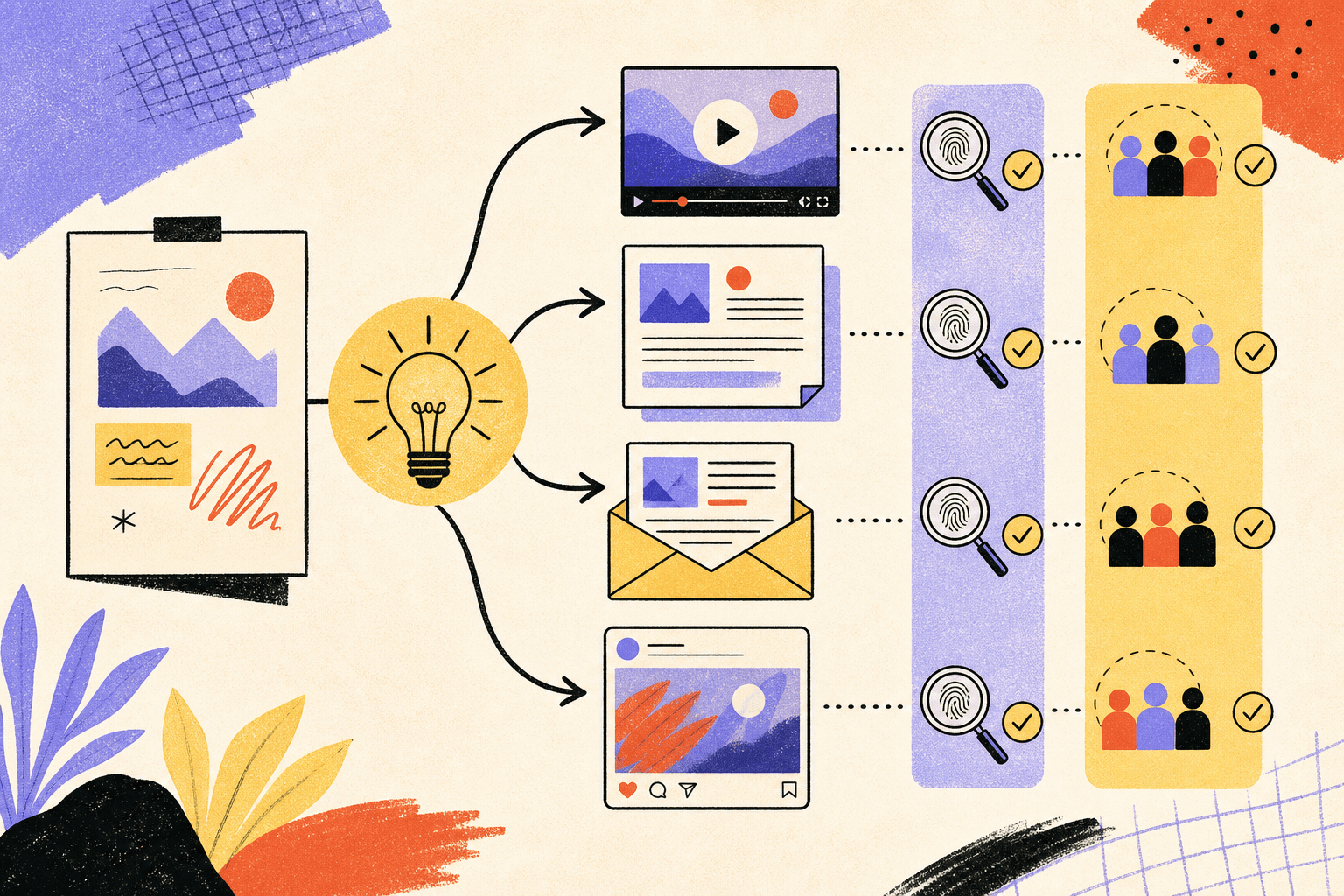
Read the video transcript
Audit the last 90 days. Posts sort into buckets by topic, format, audience, and effort so the team can spot repeatable patterns before planning. 90-day audit. Group by bucket. Find patterns. Turn insights into a plan. The team picks one goal, three to five content buckets, and adapts one core idea into native platform formats. Pick one goal. Choose 3-5 buckets. Adapt by platform. Publish, review, refine. A checklist guides publishing, originality review, results logging, and monthly decisions on what to repeat or stop. Originality check. Log results. Repeat or stop.
Look for patterns without turning one popular post into a strategy
Before planning another batch, inspect what you've already published. Group comparable work and ask what the viewer received from it.
YouTube recommends grouping content by factors such as topic, format, intended audience and production cost, then looking across a broader period, such as 90 days, for patterns. It also warns that one unusually successful video can skew an average. YouTube’s guidance on deciding what to create.
The principle is useful beyond YouTube, but the figures and comparisons still need context. A quick answer filmed at a desk and an elaborate installation video have different production costs. A customer-support explanation and a broad introductory video may be doing different jobs. Ranking everything by views alone can hide the work that is most valuable to the people already considering you.
For the hypothetical shelving brand, imagine a room makeover attracts more attention than a measurement demonstration. Before making every post a makeover, inspect the questions and actions around each. The measurement video may expose a recurring obstacle that the next explanation can solve. That possibility deserves investigation; it isn't a claim that lower-view posts are secretly driving sales.
Keep a short record of what you observed and what you inferred. “Three commenters asked about the gap above the unit” is an observation. “People are hesitant because of ceiling clearance” is an interpretation you can test in the next piece.
Give each recurring format a job
Content categories often start as labels: education, inspiration, behind the scenes. They become more useful when they describe what a viewer gets and what the team needs to produce.
For the shelving example, a measurement series could answer one layout question with a tape measure and a clear view of the product. A setup series could show one assembly or rearrangement step. A customer-space series could explore an actual use, when permission and suitable footage are available.
Each format needs a recognizable promise, but it doesn't need identical wording or editing every time. The measurement series might use a close-up for one question and a simple room sketch for another. Consistency should help the team produce good explanations, not force different ideas into a rigid visual template.
Start with a small set the team can genuinely support. If a format requires a new location and three approvals every week, account for that before making it central to the plan. A strategy that ignores production capacity will eventually be replaced by whatever someone can make before the deadline.
There should also be room to stop a format. If several attempts reveal that the topic is too narrow or the footage never explains it clearly, changing the plan is a considered decision, not a failure of consistency.

Adapt the explanation to the place people encounter it
The same idea may be useful in several places, but the context changes. A person watching a short demonstration may need to see the measurement immediately. Someone reading a longer post may want the reasoning behind the layout and the limits of the advice.
For a shelf-clearance question, a short video could show exactly where the measurement starts and ends. A carousel could let the viewer compare two arrangements at their own pace. A longer article could explain the planning decisions that are difficult to demonstrate in a quick cut. These are possible executions, not a requirement to turn every idea into every format.
Amanda Natividad's writing on zero-click marketing makes a useful case for giving people an idea they can understand on the platform where they encounter it. She also clarifies that this doesn't mean abandoning links. The practical question is whether the post delivers value before asking the viewer to go elsewhere. Natividad’s explanation of zero-click marketing.
Use that distinction when reviewing your own posts. “Read our guide to learn how to measure” withholds the answer. Showing the measurement, then linking to the full planning guide for additional cases, helps both the casual viewer and the person who needs more depth.
Make originality a production choice
A content plan built mostly from other people's footage or familiar advice leaves you with little that a viewer needs your brand for.
Meta's current Facebook guidance distinguishes original work from duplicative material and describes how it treats content that adds meaningful information or analysis. Its rules concern Facebook distribution; they should not be turned into a blanket claim about every platform or a guarantee of reach. Meta’s guidance on original content.
For the shelving brand, useful originality might be as straightforward as showing the actual product in a real space, explaining a design decision or answering a specific question with a demonstration. It doesn't require inventing a new genre of content each week.
If you're commissioning UGC, give creators access to the problem and the relevant product facts. “Show how you planned this corner” leaves space for a real explanation. Asking someone to repeat a generic script about transforming their life is much less likely to add information a viewer can use.
Review the decisions the content helps people make
A review meeting should produce a better brief for the next batch. Looking at numbers and agreeing to “keep testing” is rarely enough.
Start with what each piece was supposed to do. If the measurement video was meant to clarify fit, inspect viewing behavior alongside the questions it prompted. If viewers stop before the key measurement appears, try moving it earlier. If they watch but still ask where to measure, improve the explanation. Those are different problems and call for different edits.
You won't be able to attribute every sale or change in awareness to an individual organic post. Record the limits of the evidence rather than hiding them behind a precise-looking report. Website actions, customer questions and conversations with sales or support can inform the picture, but none automatically proves causation.
Then choose what to repeat, what to change and what to stop. Give each decision an owner and put the next useful piece into the calendar. Zagged’s organic social production and distribution supports that work across TikTok, Instagram, Facebook and YouTube, using creator videos, clips and social slideshows where each format serves the explanation. If production is where the plan keeps breaking down, bring that bottleneck to the conversation. A better partner brief names the work you need help sustaining.
Sources & further reading
- Tips to learn what content to create - YouTube Helpsupport.google.com
- Rewarding Original Creators on Facebookabout.fb.com
- Amanda Natividad: When Attribution Is a Fool’s Errand, Zero-Click Marketing Is the Waysparktoro.com
Published by Zagged Editorial. Examples are illustrative unless a source is identified. Updated .