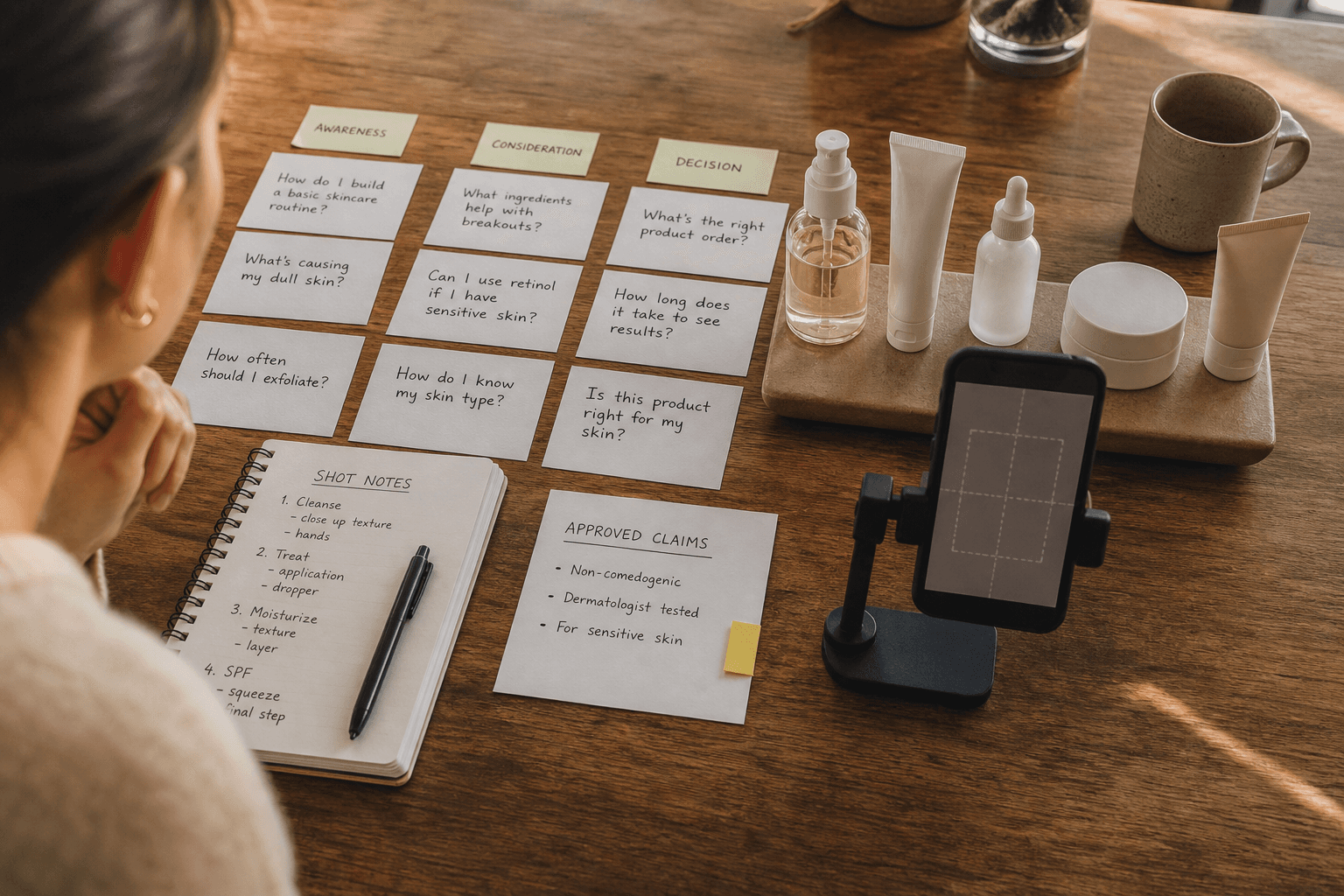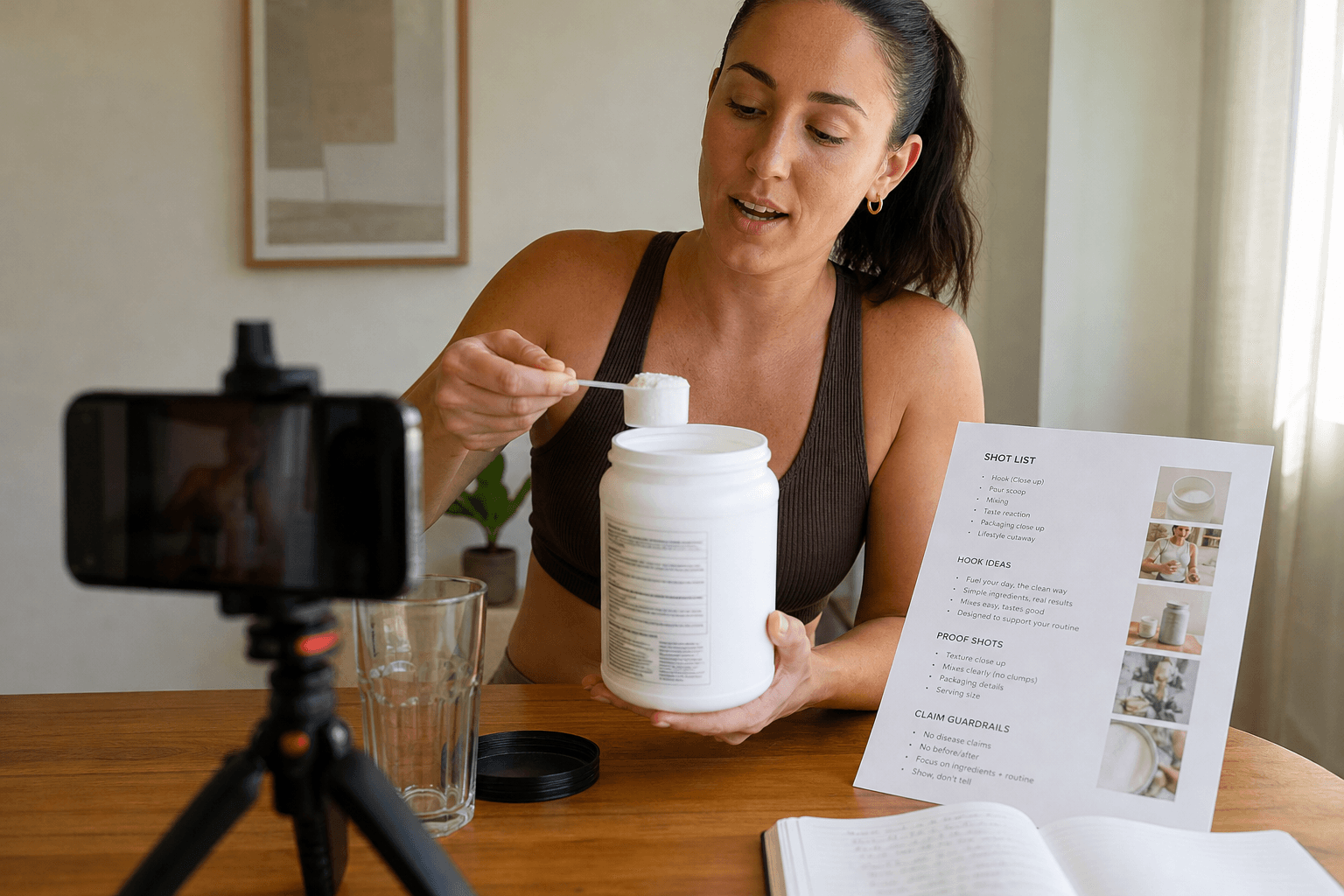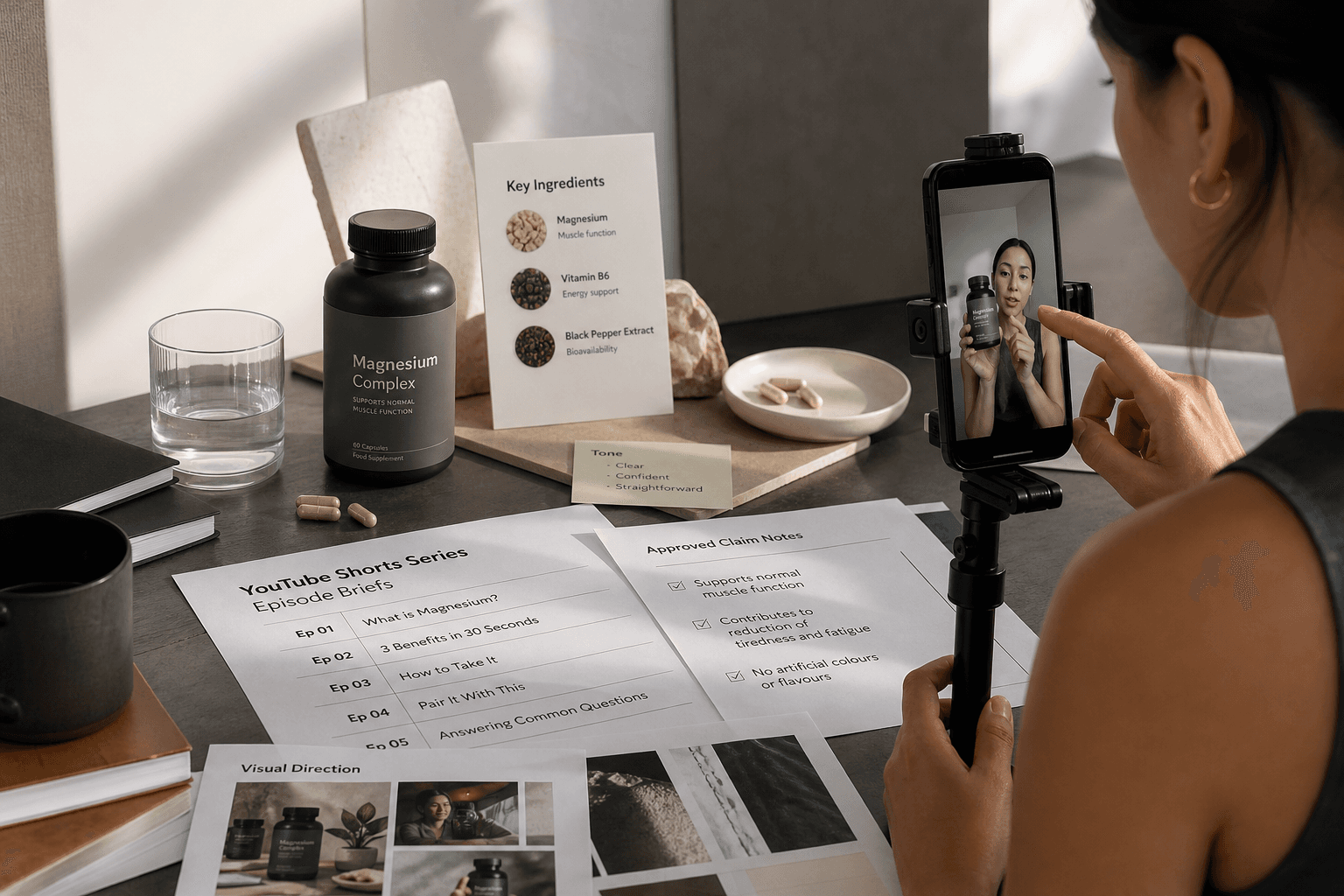
A common mistake looks efficient right up to the point it wastes a month.
The team decides it needs more YouTube Shorts. Someone pulls six cuts from existing footage. A couple are decent. The rest are filler with captions. Then the harder question arrives: what are we making next week, and what exactly are we trying to repeat?
That usually isn't a posting problem. It's a series design problem.
For most product brands, a better YouTube Shorts strategy for brands is to commission one recurring series with a stable promise, a repeatable shot list, and editing rules your team can approve without relitigating the concept every time. That recommendation is grounded in how YouTube says Shorts are surfaced: recommendations depend on viewer response and personalization, including whether viewers choose to watch, how long they stay, average percentage viewed, likes, and survey feedback. YouTube also says there is no minimum posting cadence required for videos to perform well, which should be reassuring to anyone currently being bullied by a spreadsheet (YouTube Shorts discovery signals).
So the production job is not "make more Shorts." It's "make a kind of Short people can recognize, choose, and understand again."
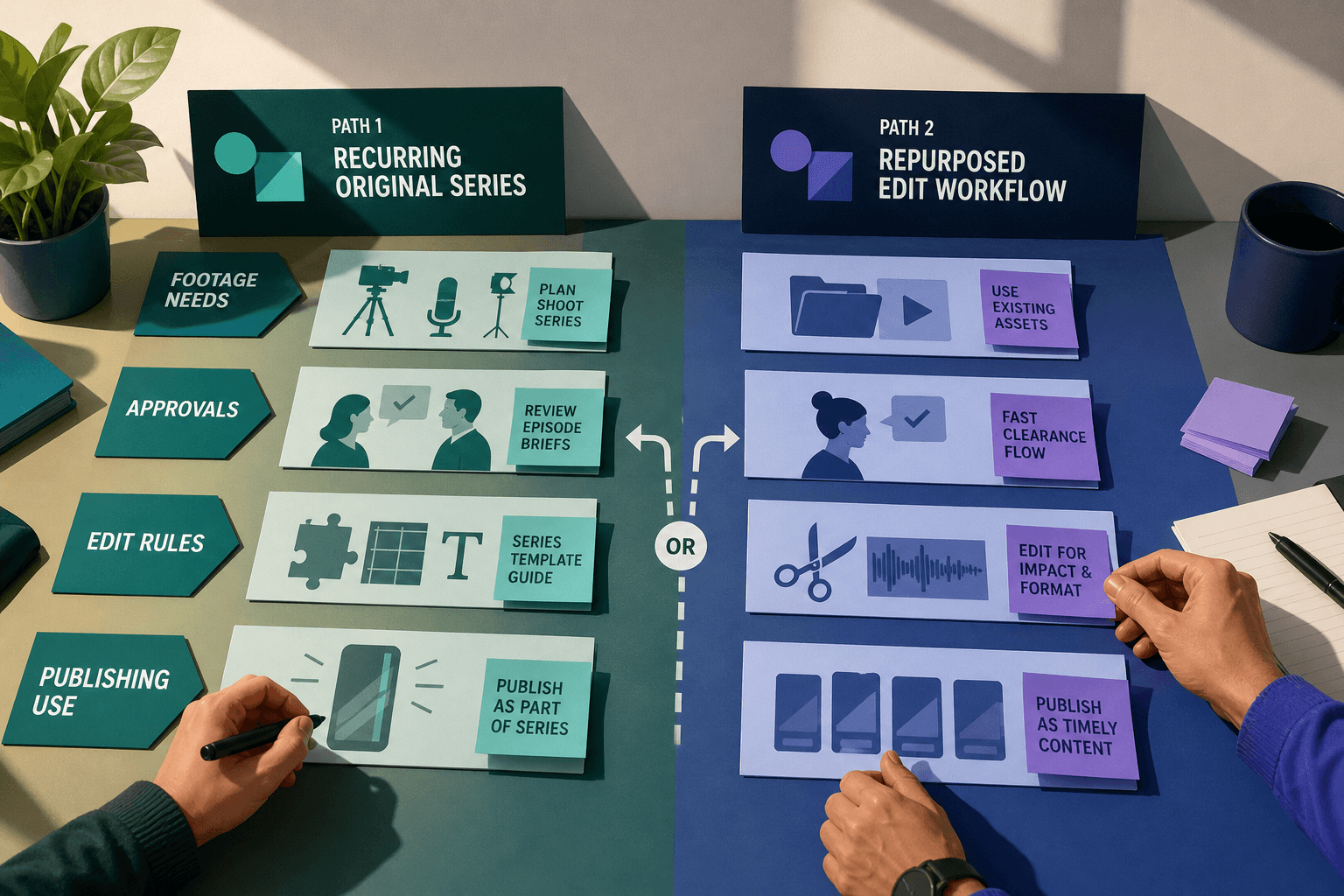
Decide whether you need a series or an editing workflow
Before you brief creators, editors, or anyone with a calendar invite, choose between two different jobs.
One is a recurring editorial series built for organic YouTube. The other is a repurposing workflow built from footage you already have: ad cuts, founder demos, creator videos, webinars, or longer YouTube uploads. Both can be sensible. They should not share the same brief.
Choose a recurring series when you want an organic presence with a recognizable point of view. Choose repurposing when your team already has strong source footage and the bottleneck is turning it into usable versions quickly. If the main task is extracting short clips from longer footage, that is a clipping assignment, and the right destination is Clippin's video clipping service. If you need ongoing planning, short-form production, distribution, reporting, and optimization across channels, Zagged's organic production and distribution process is the more relevant conversation.
A simple test helps. If this week's footage disappeared, would the concept still exist? If yes, you probably have a series. If no, you probably have an editing job.
This distinction matters because YouTube's own guidance supports experimentation across formats, and says making Shorts alongside other video formats does not inherently hurt channel performance (YouTube recommendation guidance). But that does not mean every lean team should spread effort across everything at once. In practice, one good recurring format is easier to improve than a mixed bag of unrelated attempts.
Read the video transcript
If your team keeps posting random Shorts, the real pain isn't volume. It's hitting next week with no repeatable idea, so every approval turns into another debate. What helps most is one recurring series with a clear promise, steady shots, and fixed edit rules. That makes viewer response easier to learn from because less changes each time. First decide whether you need a native series or just faster repurposing from footage you already have. If the concept vanishes without this week's clips, it's editing, not a series. Imagine a supplement brand hearing constant questions about ingredients. One repeatable Short could name one ingredient, explain it plainly, show routine use, then narrow who it's for. Next, brief a few pilots with the same structure and check whether the opening explains why to care quickly. Still, one strong format won't fix weak topics or unclear wording. A useful way forward is simple: write one sentence promising what every episode delivers, then keep proving that promise onscreen. Consistency here reduces guesswork, not creativity.
What should stay fixed from episode to episode
A recurring format is not a vow to make the same Short forever. It is a decision about what your team will stop reinventing.
Lock these five things early.
- The audience: one buyer stage or one recurring customer problem.
- The series promise: the thing the viewer will reliably get.
- The proof format: what on-screen evidence makes the claim believable.
- The footage recipe: the shots every episode needs.
- The edit pattern: opening structure, pacing, captions, and ending.
What changes each episode is the payload: one objection, one ingredient, one use case, one comparison, one mistake, one routine step.
This is the same production logic behind our guide on building an organic social strategy your team can repeat. The point is not to worship consistency for its own sake. It is to keep enough constant that your team can learn what actually changed the result.
A useful YouTube Shorts brief starts with a series promise
If the brief says "make educational Shorts" or "keep them punchy," you do not have a brief yet. You have a future argument.
A series promise should be one sentence a marketer can hand to a creator and an editor without adding three voice notes after the fact.
For example:
"Each Short answers one buying objection with a visible demo."
Or:
"Each Short explains one confusing product detail in plain English and shows where it appears in real use."
Or:
"Each Short compares one common task with and without the product."
Notice what these do. They tell the team what belongs in the episode and, just as importantly, what doesn't.
If your topics come from repeated customer confusion rather than whatever trend floated by this morning, the series is usually easier to sustain. Our article on Facebook Reels built around customer questions is useful here because the planning discipline carries over well to YouTube: start from the customer's unresolved question, then decide what proof must appear on screen.
Worked example: a supplement brand that needs explanation, not generic lifestyle cuts
Say you sell a supplement and buyers keep asking what makes the formula different. The lazy brief is "do education." The better brief is a series with boundaries.
Series name in the brief: One ingredient, one job.
Series promise: each Short explains one ingredient in plain language and shows where it fits in a real routine.
Episode unit: one ingredient per episode.
Footage recipe:
- bottle close-up with ingredient callout
- one creator line to camera
- one routine shot showing when or how the product is used
- one packaging or texture detail
- one closing line that narrows who the explanation is for
Edit pattern:
- ingredient named in the opening beat
- creator line before the first cutaway
- captions throughout
- no extra claims beyond approved language
- end on the next question in the series, not a vague "shop now"
Usable opening line:
"Magnesium glycinate sounds technical. Here's what it actually means in this formula."
A plausible cut sequence would be: creator face for the first line, quick push on the bottle label, cut to a bedside routine shot, then back to creator for the qualification.
A second episode in the same series might open:
"Why is B12 in this blend at all? Only for a specific use case, so let's make that clear."
Same series. Same shot logic. Different payload.
Now the more important part: how do you review the returned edit?
First, inspect the opening three to five seconds. Did the Short name the ingredient and explain why the viewer should care before wandering into setup? If not, change the next brief to put the plain-English benefit earlier.
Second, compare average percentage viewed across episodes with the same structure. If one ingredient keeps attention better than the others, that suggests the topic may be stronger or more familiar, not automatically that one editor performed a miracle (YouTube Shorts discovery signals).
Third, inspect comments for the same confusion you meant to solve. If viewers still ask what the ingredient does, the issue may be the wording, not the series concept. That changes the next script line, not the entire format.
This is a better review process than deciding one post "worked" because the top-line view count looked flattering in a meeting.
If you need creator-led footage for a repeated series like this, Zagged's human UGC offer is the relevant service page because it includes a concept and hook, a real creator, editing and captions, a final video file, and paid and organic social usage. As of November 6, 2026, the live UGC pricing page shows 50–200 fully edited videos at $99 each with a $4,950 minimum order. Treat that as Zagged's current public offer, not an industry benchmark, and confirm details like raw footage, revisions, exclusivity, and permissions in writing.
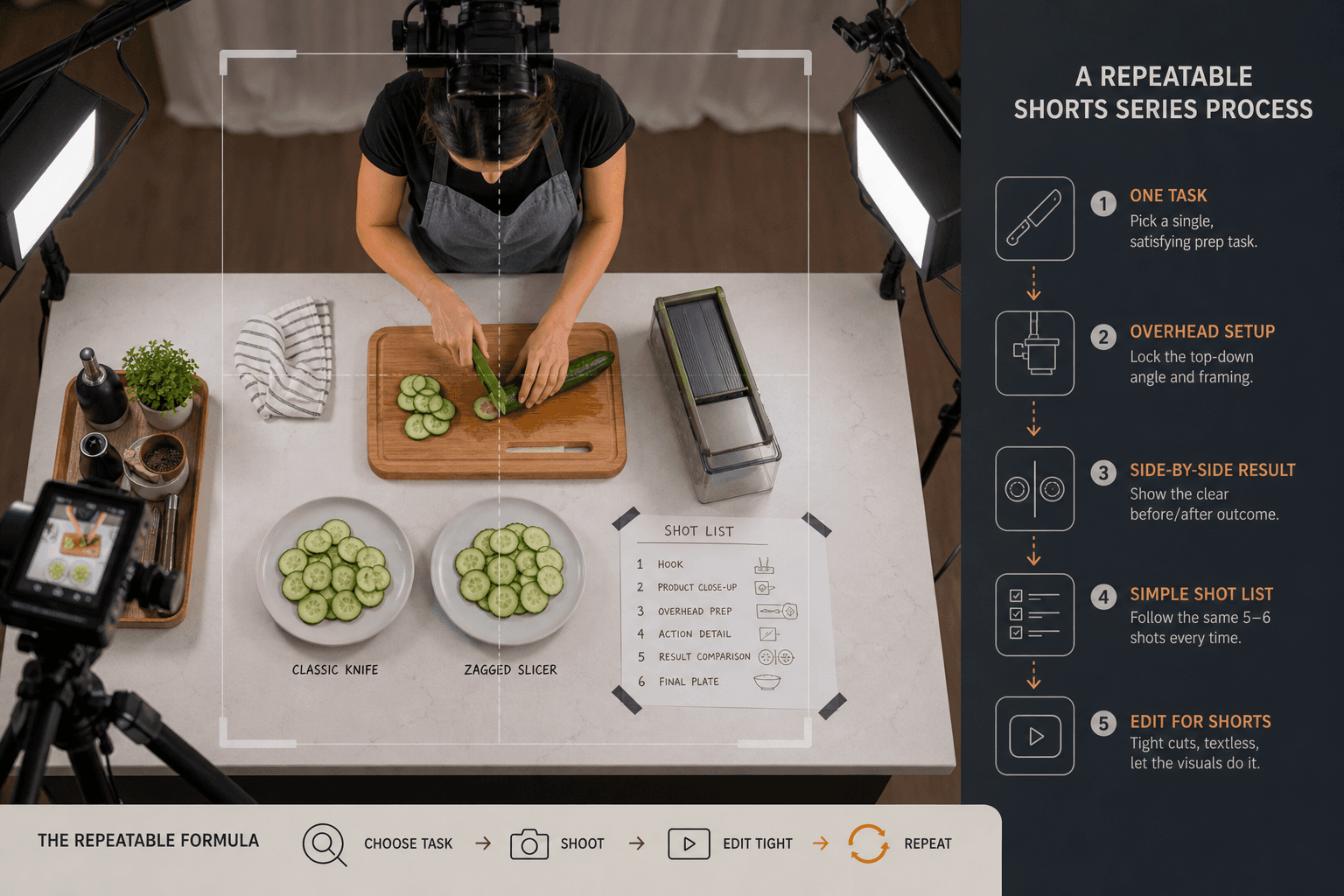
Worked example: a kitchen brand choosing between ad adaptation and a real series
Now imagine a kitchen brand with decent paid social footage already on hand. There are close-up demos, overhead shots, and some polished edits from earlier campaigns. The team asks a fair question: can we just reuse those for YouTube Shorts?
For paid placements, possibly. Google Ads says YouTube Shorts ads support vertical assets and recommends 9:16. Ads can be up to 3 minutes, but only the first 60 seconds play in the Shorts feed before a prompt to continue on the watch page (YouTube Shorts ads specs; video ad format requirements). That should already tell you paid and organic need different expectations.
For organic YouTube, I would usually not stop at adapted ad cuts. I'd brief a recurring series such as Can this replace your usual tool?
Series promise: each episode compares one common kitchen task against the usual method.
Episode 1 could be briefed like this:
Opening shot: onions half-chopped on a board.
Opening line: "If you only use this on big prep days, you're probably missing the easiest job for it."
Middle sequence: one short demo of the product handling a small annoying task, then a side-by-side result shot.
Closing line: "Best for quick weeknight prep. Less helpful if you want an ultra-fine dice."
That closing qualification is not decorative honesty. It is part of product truth. A narrower, provable claim usually gives the editor better footage choices and gives viewers fewer reasons to distrust the whole thing.
Now carry this same example into the next production decision: what stays fixed? Keep the comparison reveal early. Keep one task per episode. Keep one visible result shot before the close. Do not let episode four drift into a generic lifestyle montage because everyone on the brand side is tired of seeing the same structure. Internal boredom is not a serious performance metric.
What would make me choose differently? If this kitchen brand had a deep library of truthful demonstration footage and needed speed more than distinction, I would begin with editing and repurposing. Our guide to short-form video editing services is useful at that point because it helps you tell the difference between buying editing only and quietly asking an editor to rescue a weak strategy. But if the goal is to build an organic YouTube habit people might return to, a native recurring series is usually worth the extra briefing work.
Originality changes the recommendation a bit, not all of it
There is another reason not to confuse reposting with strategy. YouTube has said it is updating Shorts recommendations to further prioritize original content and reduce the reach of re-uploaded content with only minor edits (YouTube on original Shorts content).
That finding has limits. It does not prove every repurposed edit is weak. It does not mean one brand-new series will automatically outperform old footage. What it does change is the recommendation for organic planning: if your current approach is mostly reposting the same clips with cosmetic changes, that is a shakier bet than a series with an original editorial point of view.
So the decision is not "never repurpose." The decision is whether repurposing is supporting an editorial plan or replacing one.
What to hand a production partner before kickoff
A workable series brief needs more than references and vibes.
Send the recurring customer question or objection, the approved claim language, the proof that must appear on screen, the footage your team can supply repeatedly, and where each asset will run: organic Shorts first, paid adaptation second, or both with separate exports.
Also settle the approval path. Who checks product accuracy? Who clears claims? Who decides whether an episode failed because the topic was weak or because the cut buried the proof? If you don't assign those decisions upfront, they will still happen. They'll just happen late and expensively.
If your team mainly has long-form footage and needs Shorts cut from it, don't force a series-production vendor into a clipping assignment. Send that work to Clippin. If the issue is ongoing channel output, research, production, distribution, and optimization, then Zagged's organic production process is the right place to start the conversation.
Approve the episode against the series job
When a draft comes back, don't ask whether it is "good." Ask whether it does the job this series was commissioned to do.
For an explanatory series, inspect whether the viewer can understand the point without opening the description. For a comparison series, inspect whether the result shot appears early enough to justify the premise. For any claim-heavy product, inspect whether the footage actually proves what the script suggests.
YouTube's upload rules tell you Shorts can be uploaded up to 3 minutes and in square or vertical formats (YouTube Shorts upload rules). Those are useful constraints. They are not your editorial plan.
Make the editorial decisions once at the series level. Then your weekly approvals stop turning into taste debates.
The next move
Choose one series your team could still explain six weeks from now. Write its promise in one sentence. Lock the repeatable shot list, the edit pattern, and the review standard. Then brief three pilot episodes against the same rules and see what the audience response changes in the next brief.
Sources & further reading
- YouTube Help: Search & discovery tips - Shortssupport.google.com
- YouTube Help: Upload YouTube Shortssupport.google.com
- YouTube Help: Recommendations for YouTube’s recommendation systemsupport.google.com
- Google Ads Help: YouTube Shorts ads asset specs and best practicessupport.google.com
- Google Ads Help: Video ads specs and format requirementssupport.google.com
- YouTube Community: Prioritizing original content on Shortssupport.google.com
- Zagged organic production and distribution processzagged.com
- Clippin video clipping serviceclippin.com
- Zagged human UGCzagged.com
- Zagged UGC pricingzagged.com
Published by Zagged Editorial. Updated .