You have one approved product image, a campaign due this week, and a very modern temptation: let AI make the ad look like a real-life scene the camera never captured.
Sometimes that is a sensible production shortcut. Sometimes it is the exact moment the ad stops being trustworthy.
With AI product ad creative for Facebook and Instagram, the decision is not whether the image is "real" in some philosophical sense. The useful line is simpler: is the generated material adding context, or is it standing in for proof? If it is only helping you adapt a truthful product asset to more placements and concepts, fine. If it is showing use, results, scale, included accessories, or a person’s experience that never happened, you are no longer solving a production problem. You are creating a claim problem.
That distinction matters because Meta offers AI-assisted tools for advertisers, including creative variations and image expansion for vertical placements, which makes AI a legitimate part of the production toolkit on Facebook and Instagram (Meta for Business on Facebook and Instagram Reels ads, Meta AI on advertiser tools built with Llama). But platform capability is not permission to imply whatever the generated image suggests. The FTC standard is still the harder one: advertising claims must be truthful, not deceptive, and backed by evidence (FTC advertising and marketing guidance).
Start with the claim the ad needs to prove
Before you brief any AI creative, write one sentence about what a cold viewer needs to believe.
If the sentence is, "This product exists, looks premium, and belongs in this routine," generated scenes may be a good fit. If the sentence is, "This tool visibly improves skin," "this container fits this drawer," or "this person used the product and recommends it," then the visual is doing proof work. That is where generated scenes get risky fast.
A useful way to make the call is to split the ad into two layers.
The context layer covers things like background, lighting style, framing extension, layout, and obvious non-included props. The proof layer covers the product itself, color and finish accuracy, scale cues, texture, what comes in the box, how it is used, visible outcomes, and any implication that a person tried it.
My recommendation is straightforward: use AI freely in the context layer, and treat the proof layer as mostly off-limits unless you can support exactly what the image communicates.
That is also why some teams should edit what they already have before generating anything new. If the product is already clearly shown and the real problem is pacing, opening frames, captions, crops, or placement fit, editing Facebook ad creative before reshooting is often the cheaper and safer decision.
Read the video transcript
You’ve got one approved product photo and a deadline, so AI scenes feel like an easy fix. The risk is subtle: a polished ad can start implying proof you never captured. The article’s line is simple because viewers judge what an image seems to prove. AI can add context like backgrounds or crops, but it shouldn’t invent use, results, or included extras. Picture an electrolyte pouch shot on white. You might keep that exact packshot, then generate a kitchen backdrop and taller vertical framing for Feed, Stories, or Reels. That same ad should avoid showing powder mixed, a hand using it, or anyone reacting to taste or energy, because those details would start acting like evidence. Before generating anything, write the single belief the ad needs to earn. After launch, watch for comments about size, color, or what’s included; confusion means the scene is overselling. AI is most useful when it broadens placements and visual range around accurate assets. If persuasion depends on real handling, texture, or results, better footage matters more than better prompting.
What AI can do honestly on Meta
The strongest use for AI product ad creative is variation around a locked, accurate product asset.
Say you sell an electrolyte powder in a pouch. You have approved studio stills on white. You need Facebook Feed, Instagram Feed, Stories, and Reels versions by Friday. Meta supports placement adaptation, including image expansion for vertical formats, which is exactly the sort of production issue AI can help with (Meta for Business on Facebook and Instagram Reels ads).
In that case, you can ask AI to do the jobs that are really about context and layout:
- extend the frame for 9:16 placements
- generate a kitchen or shelf environment behind the real pouch
- build several visual directions around approved copy
- create comps for editors to finish into paid-ready variants
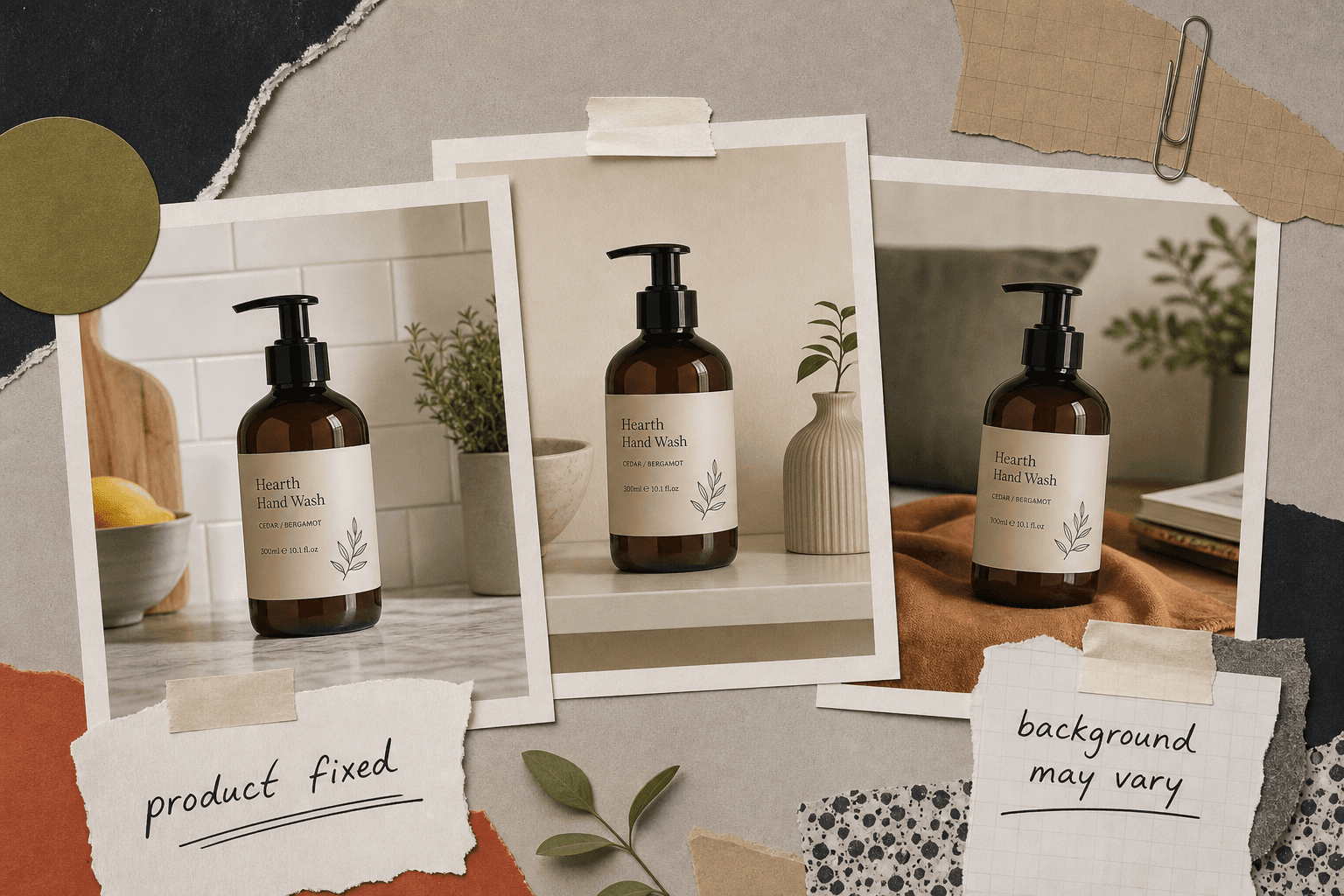
What should stay fixed is the part a buyer would reasonably treat as product evidence: pouch shape, label, cap or closure, proportion, color, and any shadow or reflection that affects how the product reads.
A brief note for that project could be as plain as this:
Lock product packshot exactly as approved. AI may generate background, surface, and non-included props only. Do not generate product-in-liquid, pouring action, hand interaction, or any visible result cue.
That wording is not glamorous. It is, however, the kind of note that prevents the ad from wandering into fiction while everyone is busy being efficient.

Where generated scenes start making claims for you
The trouble starts when the generated image changes what a reasonable viewer thinks happened, what is included, or what the product can do.
The FTC does not maintain a neat list of banned AI edits. It does say that ads must be truthful and non-deceptive, and that endorsements need to reflect real experience (FTC advertising and marketing guidance, FTC advertisement endorsements guidance). Its endorsement guidance is even more direct: you cannot talk about your experience with a product if you have not tried it (FTC Endorsement Guides: What People Are Asking).
That matters because a lot of bad AI ad creative does not merely decorate the scene. It quietly invents evidence.
For example, imagine you sell a compact home-fitness product. The concept board shows a person using it in a small apartment, then cuts to a more toned body and a line such as, "I finally found something that works in ten minutes a day." If no real person had that experience on camera, the ad is now doing several dangerous things at once. It implies user experience. It depicts use that never happened. It suggests results that need proof. It may also imply size and use conditions the product cannot actually match.
This is where a lot of teams reach for a disclosure and hope for mercy. That is not a plan. Instagram's paid partnership label applies to branded content created in exchange for value, but that is a separate disclosure issue, not a cure for misleading product proof (Instagram branded content guidance).
Worked example 1: one packshot, several honest ad variants
Let us stay with the electrolyte powder because it is a good example of when AI can help without overreaching.
You have one approved front-of-pack still. You need two hooks and several placement versions. The campaign goal is to test framing and offer emphasis, not to prove taste, texture, or efficacy.
A workable production brief might read:
Source asset: approved front-of-pack studio photo.
Allowed AI generation: kitchen background, shelf background, glassware in background only, sunlight direction, vertical frame extension, color-themed environment variants.
Not allowed: dissolved powder, scoop size changes, condensation on product, athlete scene, consumption shot, visible body result, unapproved claim text.
From that one brief, you could build two very different ads.
Variant A for Feed 4:5:
Shot 1: real pouch centered on counter with an AI-generated morning kitchen behind it.
On-screen text: "Make the morning routine easier."
Shot 2: cut tighter on approved label details.
Shot 3: simple ingredient or routine card built from approved facts.
Variant B for Reels 9:16:
Shot 1: same real pouch, vertically expanded for full-screen placement, with light movement in the background.
On-screen text: "One product shot, more than one placement."
Shot 2: close crop on the pouch and packaging details.
Shot 3: offer or routine message.
Now inspect what those edits deliberately do not show. No mixed drink. No hand holding the pouch. No person reacting to taste or energy. No gym scene that implies a result. If the campaign needs any of those things to be believable, the answer is not better prompting. The answer is different source material.
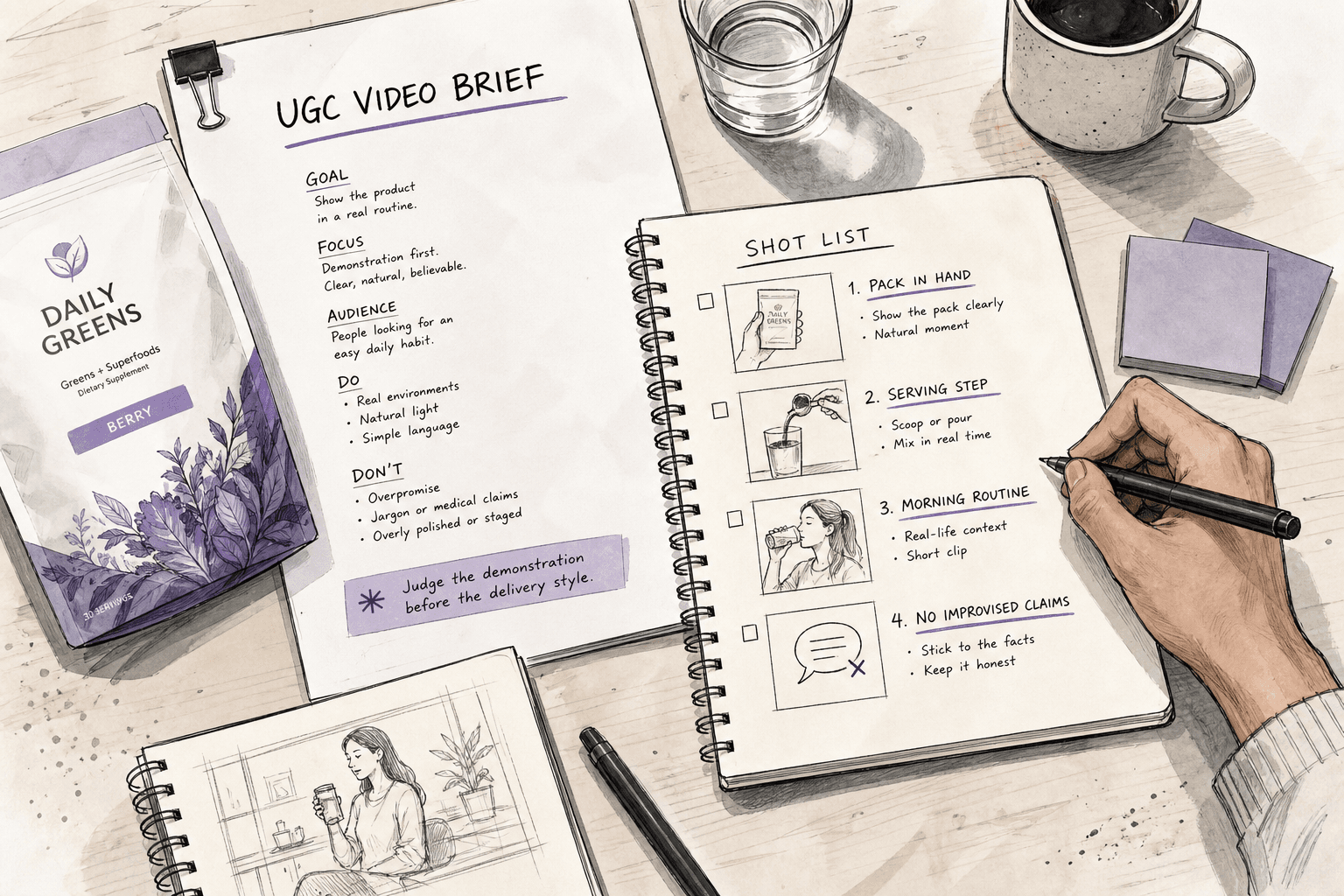
That is the same decision logic behind buying UGC videos for Facebook ads by judging the demonstration first. If the claim needs a viewer to believe use, fit, or an objection being answered, the proof has to be visible. Style can help, but it cannot replace evidence.
If you need actual human use, that is when real creator footage belongs in the plan. Zagged's public human UGC offer with real creators and edited delivery lists a concept and hook, a real creator, editing and captions, a final video file, and paid or organic social usage. Its live checkout lists 25 to 200 fully edited videos at USD $99 each, with a minimum order of $2,475 as of October 2026; confirm details such as revisions, raw footage, and rights in writing before purchase (Zagged UGC offer, live UGC checkout pricing).
Worked example 2: a skincare ad that should stop before the fake demo
Now take the same reasoning into a category where the line is much easier to cross.
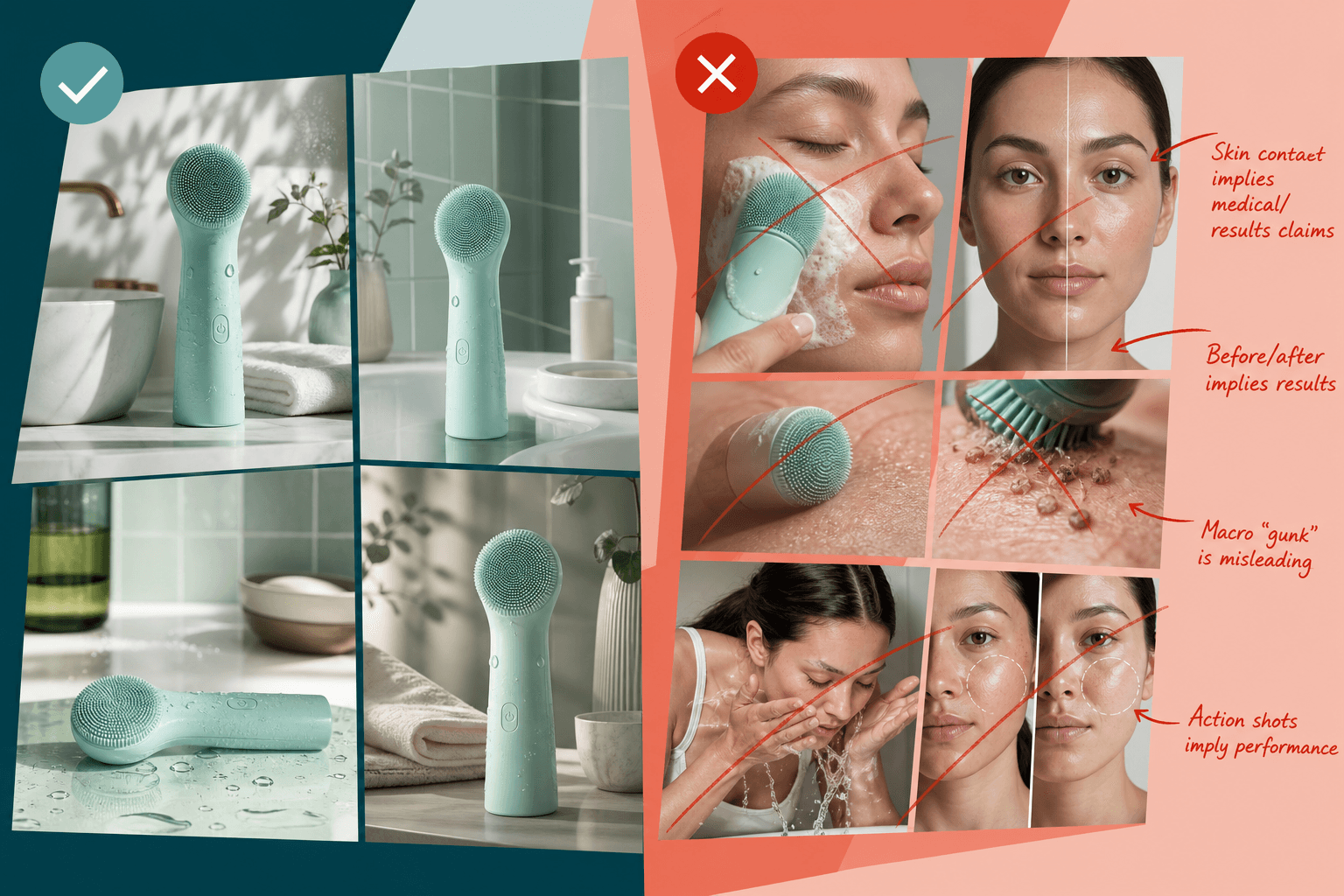
Say you sell a skincare tool. The first concept board looks polished: the device sits in an elegant AI-generated bathroom, then appears against a model's cheek with glowing skin and a line about visible improvement.
The first decision is whether the product can appear in a generated bathroom scene at all. Usually yes, if the tool itself remains accurate and the setting does not imply included accessories or a finish the actual product does not have.
The second decision is whether the tool can be shown touching skin in a generated close-up. That is where I would stop. The moment the image implies pressure, texture, how the product sits on the face, or a visible skin effect, the scene is no longer just setting. It is becoming demonstration.
The third decision is what to use instead. There are two honest options.
One is real footage showing use. If the ad needs to prove handling, contact, or immediate visual behavior, get the camera involved and deal with reality like adults.
The other is to stop pretending the ad is a demo and turn it into explanation. If the buyer's friction is understanding routine order, use case, or what the tool is for, an explanatory sequence can do the job without fabricating skin results. That is why when to commission an explanatory Instagram carousel is relevant here. Some products need a clear sequence, not a suspiciously perfect fake bathroom scene.
A decision note for the edit could read:
Keep AI environment for product-only shots. Remove generated skin-contact close-up. Replace with real use footage or an explanatory frame sequence. No generated before-and-after skin condition. No testimonial-style first-person copy unless tied to a real user experience.
Follow that example one step further into approval. If the team insists on keeping the fake close-up because it "looks premium," ask a brutal but useful question: what will a reasonable buyer think they are seeing? If the answer is "someone really using the product," the image is doing endorsement work whether your internal folder calls it a concept, mood board, or final_v7_reallyfinal.
What the research changes, and what it does not
The research here gives you a rule of thumb, not a mechanical formula.
Meta's materials support using AI for ad variation, text generation, and image adaptation across placements (Meta for Business on Facebook and Instagram Reels ads, Meta AI on advertiser tools built with Llama). That should make you more comfortable using AI to solve production range problems.
The FTC guidance is what limits how far you take that comfort. It supports the view that generated visuals are judged by the same truth standard as any other ad claim, and that endorsement-style messaging should not imply experience that never happened (FTC advertising and marketing guidance, FTC advertisement endorsements guidance).
What neither source gives you is a universal list of approved and banned image treatments. The missing piece is judgment about net impression: what does the ad communicate to the buyer in context? That uncertainty is exactly why your brief needs to name what may vary and what must stay real.
What to inspect after launch, and what the finding should change
Do not "track performance" in the abstract. Inspect the signs that tell you whether the creative stayed clear.
If you used generated scenes around a real product asset, read comments, DMs, and ad feedback for confusion about what is included, the actual color, the product's size, or whether a depicted situation really reflects use. If viewers keep asking, "Does the stand come with it?" or "Is that how it looks in real light?" the generated context is doing too much claim work. The next version should strip back props, simplify the setting, or show the real product more plainly.
If you used real creator or demonstration footage, inspect whether viewers understood the claim early enough and whether the proof arrived before they lost interest. If comments keep asking how the product is used, the opening did not carry enough demonstration. If comments attack the claim itself, you may need stronger proof, not different music.
That is close to the broader point in when to outsource ad creative editing: editing can clarify truthful footage, but it should not be asked to compensate for missing proof.
When AI creative is the right buy, and when it is not
AI product ad creative is a good buy when you already have accurate product inputs and need more concepts, more placements, and more visual range without pretending the product did something the camera never saw.
It is the wrong buy when the ad's persuasive job depends on real-world proof: fit, texture, application, visible outcome, tactile behavior, or a person's experience. In those cases, either shoot the evidence or commission real creator content that can show it honestly.
If your team can lock approved product assets, write clear claim boundaries, and review outputs against the real SKU, this work can stay in-house. If the harder part is translating those boundaries into versions for Meta placements and keeping generated scenes from creeping into product proof, outside support may earn its keep. Zagged's process for AI creative, editing, and versioning work is the relevant conversation to have there.
Make the decision before anyone starts polishing a synthetic hand onto the product shot. If AI is only changing the surroundings, proceed. If it is supplying the proof, stop and get the evidence another way.
Ad creative editing handoff
Give an editor the material and decision behind a revision. Use this to separate a new hook test from a full creative rebuild.
Attach the actual source files and reference timecodes. If a claim needs new evidence or a missing shot, ask for it before editing around the gap.
See a completed example
- What this edit should help us learn
- Example: Does showing the product in use before the explanation make the opening easier to understand? This is a hypothesis, not a promised lift.
- Source files and selections
- Link the original footage, product shots, approved logo, captions and project files. Identify the exact takes or timecodes worth keeping.
- What stays consistent
- Keep the offer, body explanation and closing request consistent when comparing the opening. List any unavoidable differences.
- What changes in each version
- Version A opens on the product demonstration. Version B opens on the problem. Specify the visual and spoken change for each.
- Placement and export requirements
- List TikTok, Reels, Facebook or Shorts placements. Verify current aspect ratio, duration, safe-area and caption requirements for those placements.
- Claims, music and permissions
- Provide approved claims and cleared music. Identify footage with limited usage rights. Do not create an unsupported before-and-after result.
- Approval and file naming
- One approver; timestamped notes; a named revision round. Use product_opening-version_placement_date in filenames so the test can be traced.
Make your own brief
Your entries stay in this tab. Download before leaving; they are not saved or sent to Zagged.
Sources & further reading
- Advertising and Marketing | Federal Trade Commissionftc.gov
- Advertisement Endorsements | Federal Trade Commissionftc.gov
- FTC's Endorsement Guides: What People Are Asking | Federal Trade Commissionftc.gov
- Instagram & Facebook Reels: Create Short Video Ads | Meta for Businessfacebook.com
- The future of AI: Built with Llamaai.meta.com
- What is considered branded content | Instagram Help Centrefacebook.com
- Zagged UGCzagged.com
- Zagged UGC Pricezagged.com
Published by Zagged Editorial. Updated .